Chinese New Year


IMG_2476

Happiness

I always celebrate the Chinese New Year. I like being aware of what energies the new totem carries, asking people which year they were born, and what the astrology says about me. And there is a certain excitement with the Lunar New Year, because it means spring is on its way.

OLYMPUS DIGITAL CAMERA

I was just out of high school when I learned there was a whole way of keeping track of time by the moon. That always felt like a more accurate way to base a calendar. Plus, I like looking up at the night sky, I like remembering that the power that moves the moon moves through me.

The study of astrology came naturally to me. For decades I did charts for people, and had causal conversations with others. It was always fun, the Chinese Zodiac, in particular.  I liked the perspective that instead of one sign a month, there was one for a whole year. Not the year like we in the West knew it to be, one that started in February, and that made a difference. For instance, my father and mother are born the same year, but he is a Dragon, and she is a Snake. (And they so are.)

The characteristics are there, for sure, with a particular bent for men, and another for women. Men who are Tigers, or Rabbits, or Dogs seem to stand out in my life. A dear female friend is a Fire Monkey, born in the hour of the Monkey. She totally fits the profile. (And is totally looking forward to this year!) I admire the energy of the creative Dragon women, and the active Roosters. My year – those of the Sheep/Goat, well, we are quite the bunch. My graduating class has yet to have a reunion, and we just passed the big 30.

bluemoonsm300Here’s an except from my memoir, A Blue Moon in China, about the time when I was 21 years old and in China having a conversation with an American woman who was 45 years old that I had met the day before. The words come basically straight from the journal I kept while I travelled through China in 1988.

Chapter Seven: The Way to Yangshuo, A Blue Moon in China

“What year were you born?” she asked, popping the pineapple into her mouth.

“I was born in the spring before the Summer of Love,” I said. I liked thinking of it that way.

“Ah, 1967. I knew we had a kinship,” she smiled. “In the Chinese horoscope you were born in the Year of the Goat, like me.” She took a sip of her drink. “Supposedly we are born to love.” She rolled her eyes.

“I know, that’s why I call it the Year of the Sheep. I like the image of a sheep grazing on a green hillside, happy as can be.”

Our year was the only one of the twelve Chinese horoscopes to have two different totems.

“Sheep are vulnerable to predators,” Sherry countered. “Year of the Goat. That suits me better. The surefooted ability to scamper a mountainside, self-reliant. Fits with me always being off on adventure.”


As a special New Year’s Gift, if you order* the softcover of my memoir, A Blue Moon in China, you will receive a little black bag that reads: If you want a vacation, go to Hawaii. If you want an adventure, go to China.

*orders from website: abluemooninchina.com, while supplies last, in continental USA only

IMG_1834IMG_1865

The two photos were taken at the Lan Su Chinese Gardens in Portland, OR. I did a reading there while on my book tour. The Chinese character was made for me. You can see a video of it on my youtube channel, only it’s sideways (I don’t know why it came out that way).


Leave a comment

Filed under A Blue Moon in China, Book Tour, China

Santa Fe, a short story

santafecover2
 

Kathy looked out the window, out across the vacant lot full of weeds, and out to the snow-capped mountains. Seeing them there always startled her, not only that they were there, but that she had an unobstructed view. It was a fluke; the neighborhood was working class poor who barely scraped together enough money to pay the bills each month. Yet here was this unobstructed million-dollar view.

Her eyes focused back in on the patch of land directly across the street. That was in keeping with the economical status of this housing development. It was supposed to be an inviting park for the neighborhood to enjoy, but it wasn’t. It was hardened desert with tough, prickly weeds. The compact dirt was covered in seeds with claws that gripped into one’s skin. The locals called these prya “goat heads;” Kathy cursed them as “satan’s bite” whenever she pried them out of her shoes and blue jeans. There was a swing set placed to one side of the park, but it only added an apocalyptic look to the foreboding landscape. It was a picture of wasted youth left to rust, untouched by the children who stayed away, playing in the street instead. But Kathy didn’t let those painful stickers stop her from enjoying the park. She loved to swing; she loved the feel of her long hair hanging loose and free as she kicked her legs to go higher and higher, then, gripping the cold metal chain, she would lean back, and feel as though she could jump straight into the heavens.

The sky here was all encompassing; ever-present, a dome of blue that felt close enough to touch so high was the elevation of the land. It was almost always without a cloud. Unless the rare storm came through. These monsoons brought her neighbors outside to watch crackle of lighting leading the long gray streams of water across the desert, sweeping in from the distant horizon. The promise of water quenching the dry desert brought with it a celebration. After the torrent passed, the remaining clouds reflected fluorescent pinks and oranges as the sun set. It was a glorious spectacle in which painters tried to capture over and over again. But a colorful canvas could never capture the smell of rain or the sound of thunder. One had to be present and experience it in the moment.

Kathy closed the drapes. The aroma of brewed coffee lured her into the kitchen. She poured herself a mug and sat down at the kitchen table. Today was a special day. It was the day the puppy was to arrive. Marcus, her husband of two years, had come home a few weeks ago full of news that Peter the potter’s hound Bonnie had given birth to a litter of puppies, and they were to have one.

“I’ve always wanted a dog,” Marcus had told her excitedly, dancing around like a little boy, his eyes sparkling at the thought of it. “My father wouldn’t allow us to have one. Now we are going to have a puppy!”

Marcus had headed out that morning in their old pick-up truck to fetch the new addition to their family. Peter and Bonnie lived in a blink of a village high up in the mountains. Bonnie was free to roam and often found herself giving birth. But she was a sweet dog, and her puppies were known to inherit her disposition.

The clock slowly ticked time away. Kathy looked around her home. They had moved in just a few months before. It was the first actual house Kathy lived as an adult. It was a new construction, part of a small subdivision four blocks long. The front windows faced south and sunshine streamed in all day in the winter, and giving the excuse to sprawl catlike on the rug soaking up the rays. To the east were the mountains. At the foot of these was the town center. They lived on the outskirts, outside the inner circle of the Plaza, where the artists converged. The old-timers who lived out their way still kept horses, grew vegetables in their gardens. Their yards were stocked with piles of scrap lumber for wood stoves and old cars for spare parts. They had chickens, too, and every morning Kathy could hear roosters crow. Life in a rural desert still felt strange.

Marcus had suggested Santa Fe as the place to settle down and begin their life together. Neither of them had ever been here before. On their honeymoon road trip across country, they drove into town one day and found a place to live. They were transplants from a cosmopolitan city. Romantic notions enticed them there, believing this fringe art community would be the place to do something unique, special, impactful on society. What that might be Kathy still didn’t know.

Kathy and Marcus had grown up in Chicago and their new friends came from all over the country. It was a gathering of neo-hippies into the desert, fellow seekers of some intangible purpose for life, of some sort of an answer for their reason for being alive on the planet. She knew it was the bright sun by day and the sky full of twinkling star by night than attracted them here. She wondered if the landscape full of sweet sage and pungent pinon was what held them captive. The wind blew in the expansive sense of freedom, of anarchy, of personal responsibility, and of self-expression. The elevation intensified the sensation. But the bewitching elements seemed to affect everyone different. Some people soared like the eagles, finding their passion and following their bliss. Others went crazy, as if ghosts thrived in the thin atmosphere, haunting them, taunting them until they were driven to jump off a bridge.

What happened to a person when they live where the sun loomed so close a T-shirt can be worn cross-country skiing? When a person moved from crowded cities to a state where the entire population is less than that of a typical suburb?

Space. Space to breathe … to dance to one’s own tune with arms open wide, twirling around without fear of collision. But with that space, Kathy was discovering, came a disorientation, a restlessness, and a recklessness. She felt it within herself. And Marcus certainly seemed to be experiencing something of that nature. He seemed unhinged, lost without the towering sides of skyscrapers defining and restricting his existence, without the crisscross of boulevards and highways. There was no road map in this open land, no paths laid out to follow. Everyone had to decide where they wanted to go and how they wanted it get there. Most often making it up as they went along, like setting out on skis after the snow covered the fence line. You could go anywhere you wanted, but it was up to you to decide where that was to be, and breaking a fresh trail required considerable effort.

Kathy sighed. She knew she had taken the easy way out by going to college. At least there she had a focus, her goals were laid out for her: finish this homework, complete that class. But Marcus had decided to be an entrepreneur, to live the American Dream. He had spent the last couple of years trying one idea after another, but only succeeded in creating one bad scenario after another. Kathy couldn’t understand what was driving him. Why wasn’t he pursuing his art? He was consumed with being in business for himself. It didn’t even seem to matter what that business was. Maybe that was the problem, she concluded. Nothing he was working on was truly a passion for him.

It would be hours before Marcus returned, maybe all day. Peter was a man of few words, and Marcus liked to talk. Kathy relished the time alone. Her mind began to drift into thoughts about her marriage and, then, about her life in general. The sudden biological urge she was experiencing recently brought her animated visions of children. It was only natural: she was 24 years old and married now. Her body was ready, and on the outside it looked like her life was in place to start a family. Kathy shook her head sadly, she heard her best friend’s voice still echoing in the room from a recent visit: “You are going on and on about having a baby, while at the same time you are going on and on about how unhappy you are in your marriage.” Mary had popped the bubble on her rose-colored dream of a happy little family complete with a baby bouncing on her knee.

Mary was right, of course. She always was. As the eldest of six, Mary had a way of saying it like it was. There was never time to sugarcoat a situation in her mind: see it, say it, and move on. There was something very calming about her direct approach; one didn’t have to second guess or assume what Mary thought; she just said, but somehow she did so in a very mothering way.

Kathy poured herself another cup of coffee, trying not to spill the hot liquid as she walked across the new pale beige carpets to the couch. Set against the cream colored walls, the monotone effect of the room was a soothing, neutral backdrop to the colorful drama of her everyday life. Most of which she could do without, she decided, but couldn’t do anything about. Marcus had a way of needing constant approval and constant attention, and yet, try as she might, nothing she did was enough or was the right thing at the right time. The difficulty came with that she was expected to fix everything and make it all better. She blamed his parents really; his mother in particular. She babied all three of her children, catering to their every whim, even serving them breakfast in bed. It was too much to follow and Kathy fell short on a daily basis. Typical, she laughed to herself. Don’t all psychologists end up blaming the mother? And to think she wanted to be one herself!

The afternoon sun began to fill the room. Kathy set her coffee down and stretched out to enjoy its warmth against her skin. It was pure luxury.

Mary’s visit earlier that week had rattled Kathy. They had been sitting at Kathy’s beloved kitchen table, a classic 1950’s chrome piece with a turquoise enamel top embedded with gold stars sparkling. She had found at a garage sale, and now cherished. The table somehow represented the promise of a settled life and a happy home, conventional and simple, pearls and pumps. In that fantasy the road maps were inherited by the previous generation; roles, defined; goals, set. Kathy laughed at her naivety, as if filling her home with certain objects would make a fantasy come true. But that picture was an out-dated, impossible dream today. The world was different, at least for two people with an artistic nature on a spiritual quest.

Mary’s voice came through once again. “When did you first notice that something was wrong?” Mary had asked.

“It started at our wedding.” Kathy admitted sitting across from Mary. She could feel herself cringe at the memory of it all.

“Your wedding?” Mary repeated, “What happened?”

“Well,” Kathy began slowly, fingering the top of her mug, avoiding Mary’s probing eyes, “You know how the bride and groom are supposed to dance the first dance?”

Kathy caught Mary’s nod out of the corner of her eye, “Go on,” Mary urged gently.

“The band had started to play. But Marcus was nowhere in sight. I walked around everywhere looking for him. Finally I found him hiding on a porch. I told him it was time for our first dance. He recoiled from my touch and snarled: ‘I’m not embarrassing myself in front of everyone.’ I felt a shock to my soul, to the very core of my being. One of the things we loved to do was dance together.”

“Oh, honey,” Mary reached out and touched Kathy’s hand.

Kathy looked up, trying not to cry, “I had to go back alone. Everyone was looking at me. Luckily a dear old friend rose to the occasion. We danced the first dance, then the second. Finally everyone got up and we danced the night away.”

“Did Marcus ever join in?” Mary asked.

“Yes, eventually,” Kathy replied, “but by then I was already feeling timid and questioning what I had done.”

She was still questioning her decision to marry Marcus. That her judgment may have been so totally erroneous gnawed at her confidence. There had been early indications that her choice may not have been a good one, that underneath Marcus’ charm demonic forces were ready to attack her. Demonic? Kathy sat up. Suddenly, she felt vulnerable and cold, startled by that choice of word. Where did it come from? It was extreme, yet accurate, she admitted. Marcus’ attacks always took her by surprise, knocking her sense of self so off balance she couldn’t respond in the moment. Instead she found herself rendered speechless. This from the man with whom she had promised to spend her life with. He didn’t seem to like her. Frankly at times it seemed as though he hated her.

“It’s bipolar behavior,” Mary had told her that same sunny afternoon.

“What does that mean?” Kathy asked.

“It’s the jumping between two extremes, like love and hate. Bouncing between feeling elated and depressed. Highs and lows.” Mary said.

“It feels like one part of him loves me and another part hates me. I never know which part I’m going to get. The problem is that I love him; I want to be with him.”

“You mean, the fun him, right?” Mary countered. “You don’t want the side of him that is so mean to you, do you? Or lays around sulking in a deep depression, always demanding?”

“I don’t know.” Kathy shamefully admitted as she got up from the table. She went to fill the kettle for more hot tea. The sound of the water from the faucet silenced their conversation for the moment. Mary waited, quietly watching Kathy’s movements. Her steady gaze felt unnerving.

Kathy turned to question Mary, “What does it mean when you say: for better or for worse?”

“Not abuse,” Mary said.

“He doesn’t mean it.”

“Mean what?!?” Mary asked. “To hurt you? Emotional and psychic abuse counts.”

“He can’t help it,” Kathy could hear herself almost pleading for Mary to understand.

“Okay,” Mary’s voice softened, “I’ll give you that when a person is manic depressive, it is thought to be a chemical imbalance in the brain. But my point is that the way he attacks you, the words he chooses are intended to belittle you and you end up always questioning yourself.” Mary’s voice sounded angry. “You have lost trust in who you are because he is always cutting you down. It is not ok to let yourself take the abuse!” Mary slammed her hand down on the table. Kathy was startled by the intensity of emotions Mary was showing. “Look, if he doesn’t think he’s doing anything wrong, he’ll just keep doing what he’s doing and taking no responsibility for his actions. And you let him! You just roll over and take it, as if you deserve it. You don’t! No one does!”

Yet, Kathy felt this deep-seated sense that not only did she deserve it, but somehow it was her responsibility to stay and help, to make it better, to do everything she could. She was his wife. Though it did occur to her that that might be the problem. Before the wedding they dwelled in the bubble of being “in love,” of just being happy to be together without a care in the world. It was all light and simple. And it still was – half of the time.

Outside the afternoon sun was beckoning her. She made her way out to the fresh air. The strong odor of horse manure mingled with sweet sage. It was cool, yet warm, another one of those oddities living in the high desert. She made her way to the swing set and sat down. Soon she was spinning in little circles, finding joy in the winding and unwinding. Round and round she went, until the motion ceased, and she was still again.

She felt as though everything wrong or bad that happened was her fault. Deep inside herself she felt a dark void, a blackness, an empty pit. She had felt that way her whole life, as far back as she could remember.

Kathy looked out to the horizon. The mountains had lost their dimension. There were no shadows. They looked flat, a dark tone of purple, cut out against the blue sky; they didn’t look real.

Was her marriage real? Kathy wondered. They had had an informal ceremony by a Justice of the Peace. She shook her head at the irony. Marcus had proposed over the phone, in an off-handed way. He had gone on a “life-altering trip” overseas. While he was away, he decided it was time for them to be together in a formal way. His call came through as a total surprise for Kathy. Her fear of irrevocable decisions was abated by a voice that said: You can always get divorced. Now she was faced with the prospect of divorce, and that was an irrevocable decision.

The wind rustled through the dry, sharp grass; the desert was beckoning. She suddenly felt the need to go for a walk and got up from the swing. She stepped carefully through the barbed-wire fence and found herself in the open land. She felt a rush of exhilaration. The ground was rocky, but she didn’t care; she felt protected in hiking boots and blue jeans. Here and there, cacti grew with their long, spiky arms stretching up and out toward the blue sky. In the spring these very hostile beings sprouted flowers, as if to say: yes, even that which hurts can still bare beauty. Some of the plants were dead, left with only their skeletal spines exposed to harden in the harsh elements.

“I want to buy all this land and put in roads and build a hotel,” Marcus had said to her one day.

Kathy didn’t want to see it. She liked the romance of the old ways.

“Everything changes,” he stated. “And I want to be rich.”

“I guess so,” Kathy said. I guess so echoed through her mind. Marcus had changed. He had gone from an artist, expressing himself through paint on canvas, to a man focused on the almighty dollar. Gone was the man who wanted to see the world, and now replaced by a man in search of validation in as close to the conventional world as he could possibly tolerate, his own boss in a business venture. Kathy had asked him once why the change had happened. “I became a husband,” he told her, like it was totally obvious and expected. It was as though he believed being a husband carried with it a paradigm that didn’t allow him to be an artist. She didn’t know what to say in response. He always spoke with such assurance and authority. Perhaps his idea of how a husband should act and be in the world over-ruled who he actually was.

Kathy scanned the desert before her, shielding her eyes from the bright sun. A stray dog hunted up ahead; his nose followed the scent of a rabbit, in the vain hope of catching his dinner for the night. Kathy crouched down and watched the dog. His large, thin shape and gray-white coloring reminded her of Lucy, the first family dog.

Kathy remembered the night Lucy had become part of the family like it was yesterday. It was in the dead of winter, with the kind of cold that cuts through the layers of coats and sweaters, right through the skin to the bone. Her younger brother had given the stray some of his sandwich. That was all it took. Lucy followed him home from school and stood at their side door. Her father was away at a meeting, leaving her mother alone to deal with three distraught children, tearfully begging for mercy for the very dirty, determined dog shivering in the cold, night air.

Kathy could well remember her father’s tone of disapproval coming through the phone, and her mother’s face turning red at the injustice of it all. Looking back, Kathy could see how trapped her mother must have felt, pinned in on all sides by a situation she had done nothing to bring about. She herded the three of them to bed, simply saying: “We’ll see what happens.” Kathy was sure now that she was silently cursing her father’s unreasonable ways.

According to what was now family tales, when he pulled into the driveway late that night, the next door neighbor caught his attention with a sharp rap on her kitchen window: “You’re not going to leave that dog to freeze to death, are you?” There was nothing he could do, but give way to the force aligned against him. Kathy was sure the image of the dog lying there dead in the morning was more than he was willing to face. After her mother gave him a piece of her mind, she bathed the dog who was soon named Lucy. The pathetic creature sat still while being scrubbed clean, knowing she had won the war. Kathy came to love that dog and her gentle manner. Many times she cried the tears of a sad, lonely child, finding solace by holding Lucy close. She had become her best friend. She told her secrets and felt protected in her unconditional love. She had held her as she was dying.

Kathy sighed as she stood back up. What was she hoping for with the arrival of the puppy? That suddenly everything was going to be okay or somehow make sense? Was Mary right? She just wasn’t sure.

It difficult to make a clear decision and know what was the right thing to do. Her heart was conflicted. She didn’t like how Marcus treated her when he was in one of his many moods, but then he would come to her with love and wrap his arms around her. She would melt. She loved to be nestled up against him; she loved the smell of his skin, the touch of his body, the glimmer in his eyes when he looked at her. They laughed together and had fun. They could talk about art, politics, and shared an interest in other cultures. But then he would become cruel, verbally lash out at her. These thoughts chased around, rambling, contradicting, melding, repelling. It was exhausting. She felt like screaming.

The stray dog finally caught the scent of a rabbit and was off running. A hawk flew overhead. Kathy paused to listen to the sound of its wings as he soared through the air, circling around again. She stepped back through the fence.

“Now what?” she asked herself. She knew nothing, but to know nothing must be the beginning of something, she reasoned.

Yet loving a man who could not be pleased or satisfied was a burden beyond words. The heaviness wore her spirit down. Kathy felt in her bones that it was her duty to make it all better, to do everything she could to make him happy. Deep down inside she felt she could, and therefore should, do just that. She would worry about herself later; she wasn’t that important. Kathy stopped dead in her tracks. A chill went down her spine. Where had this thought come from? She wasn’t important? Kathy felt the tears roll down her cheeks as she ran back to the house. Her whole being wanted to crawl into bed, hide under the blankets and disappear.

She pushed open the door. The house was quiet. Only the ticking clock disturbed the peace. Kathy gave into her sorrow, her distraught, and ran into the bedroom, pulling the quilt over her head, sobbing. Until she couldn’t cry anymore. She lay curled up in a ball praying for guidance. In time, Kathy heard a gentle voice say to her: “Forgive yourself for everything you think you have done wrong. Everything was going to be alright. One way or another it would all work out.” Kathy was determined to believe it would. “There is nothing to fear,” the voice went on. The wisdom told her she was loved; she just had to love herself. Kathy lay still, allowing the words to penetrate her being. After awhile, she rolled out of bed, went into the bathroom, and splashed water on her face. She looked at herself in the mirror. The woman staring back, with puffy red eyes, smiled. She did matter. She had to take care of herself. She wasn’t sure how, but the answer would come. One thing she knew was that the puppy wasn’t going to fix what was at the heart of the problem. In a flash, her next move became clear. She had to leave the house, her marriage, and Marcus returned. She knew she would fall in love with the puppy and hide behind its affection. She would hold onto to the dog for dear life, while hers slipped away.

As if guided by an unseen force, Kathy grabbed a bag and threw in clothes, books, and her jewelry. Tears streamed down her face, blurring her vision as she looked around at the home she loved and was leaving. She had to get out before she was trapped. She knew it in her bones: it was now or never. She pulled the front door open. A coyote howled off in the distance, welcoming her in the unknown.


Leave a comment

Filed under Short Story

Excerts from A Blue Moon in China – Musings on the One Child Policy in 1988

People on a bus in Guangzhou, China 1988

People on a bus in Guangzhou, China 1988

From Chapter Three, Black Bicycles set in Guangzhou, China

A billboard caught my eye. It was a picture in pastels of a smiling mother, father, and a very round little girl with rosy cheeks. Curiously, the message was bilingual, both in Chinese and in English: One couple, One child. I had only recently heard of the One Child policy. It was a collective effort; sacrifice really, for the good of the country, a necessary measure for population control, handed down from the government. It looked like Big Brother in action. I wondered how it was enforced.

From Chapter Seven, The Way to Yangshuo

Sherry and I stopped for a moment to sit on a park bench. Across the street was a billboard for the One Child campaign.

“Do you know why it’s in English?” I asked her.

“Propaganda of some nature, I’m sure,” she said. “I did hear that birth control is widely available and that women are ‘encouraged’ to have abortions.” Sherry made it clear there wasn’t much choice. “What grieves me is the killing of baby girls. The rumor is they drown them. At least out in the countryside. The Communist Party doesn’t condone the infanticide, but certainly seems to have turned a blind eye to it.”

I was stunned. I didn’t want to believe it. At first I couldn’t speak, then I stammered feebly, “That must be heart-wrenching for the parents.”

“A male farmhand is more valuable than a female,” Sherry stated matter-of-factly. “Maybe it’s easier to do it because males have always been highly prized in traditional Chinese society. The old concept that females are expendable, less valuable than men – being that they are merely there to serve, lingers tenaciously on. We have Confucius to thank for that.”

“Confucius? How?” I was surprised. “Didn’t he preach virtuous conduct and being a good person? Noble pursuits? How does that translate to favoring men over women? Wasn’t he about the betterment of society?” I felt so upset I was babbling. Confucius says… I took a breath, shut up, and looked out at the city. Who was I kidding? I knew the words of well-meaning influence have often been perverted throughout history. Just about every wise man’s benevolence had been manipulated by the corrupt in search of power. I knew that ordinary men dominated most societies, many with an aim to keep women submissive and in the background. Barefoot and pregnant was the phrase that came to mind.

“It’s all a matter of interpretation, isn’t it?” Sherry’s voice was cold. “Anyway, it is a rare culture than honors women. You know that.”

I stared up at the billboard and wondered what other choices this country might have to keep its population down other than to regulate the number of children born. I had a feeling, religious belief or not, that having an abortion was a big deal emotionally, regardless of the reason. I totally agreed with the legal right for a woman to choose; it is her body and raising a child is a big deal. I was lucky I lived in the U.S. and had the right to decide for myself what I felt was best.

Young girl on a boat to Yangshou

Young girl on boat to Yangshuo

####

A Blue Moon in China is my memoir about the 2 months I traveled through China in 1988 when I was 21 years old. I went alone with only $400 in my pocket.

Buy My Book here

ebook coming soon

Leave a comment

Filed under A Blue Moon in China, China, Women

A paragraph from A Blue Moon in China, musings on the One Child Policy

“I stared up at the billboard and wondered what other choices this country might have to keep its population down other than to regulate the number of children born. I had a feeling, religious belief or not, that having an abortion was a big deal emotionally, regardless of the reason. I totally agreed with the legal right for a woman to choose; it is her body and raising a child is a big deal. I was lucky I lived in the U.S. and had the right to decide for myself what I felt was best.”

A Blue Moon in China

one paragraph of me contemplating the Chinese One Couple One Child policy in my travel memoir set in 1988.

Leave a comment

Filed under 1988, A Blue Moon in China, China

Me, a friend & Detroit’s Dally in the Alley

Early Morning Sunlight

The alley where the Dally began 38 years ago.

It was 6:30 in the morning. The streetlights were still on. I parked my car up against a garage door in a timeworn alley paved with red brick. It was more like a small courtyard, with wooden balconies jutting out from the assortment of apartments built nearly a century ago. In the center of the space was a large, graffiti-covered dumpster. I poured myself some coffee from a thermos and awaited further instructions from a friend. I was there to vend in the annual Detroit event known as the Dally in the Alley. There was already a bustle of activity. People in pink shirts were directing vendors driving in. Tents were going up, and cars were being unloaded. Vendors are amazing people to me. They trudge to some outdoor festival with a truckload of stuff, arrange everything, and spend all day in the elements talking to all kinds of people, then teardown, re-load, and go home after a 17 hour shift. I find their commitment admirable.

I noticed a large hand-painted sign informing fairgoers that everyone in the neighborhood parks elsewhere for the day allowing the festival to completely take over. I smiled knowing the spirit of sharing still remained strong.

I knew this neighborhood well. I lived around the corner in the ‘80s. At that time it was known as the Cass Corridor. My friends were hippies and musicians. There was a co-op and a few art galleries. Not too much else. A decade ago the Corridor was renamed Midtown, and new enterprises keep popping up.

Except for an awkward, and brief, first-meet date a few years ago, I hadn’t been to the Dally since 1986. I remember the one and only stage not having speakers back then. The Jug Band was one of the featured acts, and they were acoustic. A girl named Sally played the accordion and a man named Ralph played a washboard. I remembered there were a couple of tables with goods for sale, and artists displayed their paintings. It was an event by and for the people of the neighborhood. Back then the population was rather sparse; it was an intimate affair.

All I knew about the Dally in the Alley 2015 was I had to be there at 6:30 in the morning to meet my long-time friend, Zana Smith – owner of the urban boutique Spectacles. I wondered how the day would unfold. I was curious to check it out from behind the scenes, but I knew I wouldn’t do what I was about to do for just anyone.

Zana at her store. That's my book.

Zana at her store. That’s my book.

I met Zana in 1986. I was working in an old fur-processing factory that had been converted to an indoor shopping mall connected to a newly built monorail loop. I walked to work to spend my day in what would become a failed experiment of retail stores downtown. Hudson’s was already closed and there weren’t very many businesses open. En route one day, I happened upon Zana’s store. We have remained friends ever since.

Spectacles is still located at 230 East Grand River, across from the new YMCA. Zana has kept her business going for 31 years. To me that is a feat among feats. Only a few stores, like Henry the Hatter, and Wolverine, have managed to maintain longevity in Detroit.

This year somebody bought the building in which Spectacles is housed. Eviction notices were sent out. Newspaper articles were published about the goings-on and the local community was in an uproar about the loss of a landmark business. A month later the owner requested Zana stay. After much ado, it turned out her store was just the kind they wanted in their building. But now the question was how to get the word out that Spectacles would remain.

I received a text from Zana a week before. It simply said: I’ve paid for a booth at the Dally. I knew she meant: Will you be there with me all day? I gulped. But I saw the brilliance of the PR, so I told myself if she could do it, I could do it, and volunteered. Zana scored a great spot just down from the Electronica Stage – perfect for us as we all like that music. The “us” included DJ/dancer Steve who works at Spectacles, and a new person I now call a friend- Corky. Having a booth at the Dally was his idea. He promised to help out and proved himself to be a man of his word. Three young entrepreneurs – Wink, Tracy, and Chinonye – shared Zana’s booth. Wink had photographs she had taken silkscreened onto shirts, Tracy sold purses, and Chinonye offered handmade apothecary. They exuded excitement and enticed all to share in their glee. It was a celebration of making things happen for one’s self.

The day was mellow for me. Most of the time I sat in a chair on the sidewalk behind our booth, drinking coffee, and eating my snacks. A constant stream of people walked down the street. Some came in to shop, say hello, or give a hug – old friends and new ones. At one point it looked like rain, but it passed.

SuperDre in the basement of the Detroit Historical Museum.

Sometime in the afternoon a DJ took the stage and I couldn’t help but stand up, grooving to the beats. I shouted to Corky: Who is this spinning? It’s great! He shouted back: Come on, let’s go! We ran to the stage. As we came up on it I saw a familiar ‘fro. It was SuperDre! I was so excited! I had met her the previous winter. She was spinning at a fundraiser in the basement of the Historical Museum, but her volume was turned way down. She and I connected both having lived on the West Coast and sharing the astrological sign of Taurus. Her live mix was kicking – seriously fabulous layers of rhythms.

When twilight came I moved to the front of the booth to sit on a stool and watch the ever-growing crowd walk by. A good friend of Zana’s stopped and offered to buy us dinner. I went with him to help bring it back. I was happy to be moving as it was a little chilly. At this point I had only ventured as far as the original location of the Dally in the Alley. The food stalls and the third stage beyond that were new to me. Then it was decided we would walk to Cass Café to get food instead. On the way over I was completely blown away by how big the Dally actually is. There were two more stages and what looked to be thousands of people who had come down for it. There was performance art, sculptures being created, and lots of goodies for sale. For blocks and blocks. I had no idea all this had been going on all day.

The Dally in the Alley is special, from its humble beginning literally in an alley to what I witnessed this past weekend. It is an event that has been put on for 38 years by an all-volunteer staff, from the planning to the garbage clean-up. Everyone does it because they want to. It is well-organized and has a great vibe. And whenever so many people from all walks of life, maneuver around each other, elbow-to-elbow, and everyone gets along and has fun, well, that is a beautiful thing to me.

Elizabeth Pilar is an awarding-winning short story writer from Detroit. Her debut book, A Blue Moon in China, was just published. It is the memoir of the two months she traveled through China in 1988 when she was 21 years old. Her editor is Christopher Ross.

You can buy my book here.

Leave a comment

Filed under Detroit, Essay, Photos by me

A city so nice I went thrice, then I went again.

NYC graffitti covered van

IMG_2309


The first time I went to NYC was in 1986 when I was 19 years old. It was the 100-year anniversary of the Statue of Liberty and a big celebration was planned. I was supposed to meet a friend who flew in from Detroit ahead of me, but we didn’t connect. There I was, alone at the airport, without a place to stay. Luckily my mom had given me my cousin’s phone number, “just in case.” I put a coin in the payphone and crossed my fingers he was home. He was. I got on a graffiti covered subway car, then transferred to another one just as gritty, and climbed a set of stairs out into the lower eastside of Manhattan.

It was late, but people were everywhere, many sitting on blankets on the sidewalks selling all manner of things. I’d never seen anything like it. It was a night bazaar. I quickly realized most were probably homeless and earning money so they could at least eat.

My cousin lived in a small cellar studio apartment. It was crammed full of everything, including a girlfriend. She took my surprise visit well, and we three walked to the firework mega-display together. What a blast that was.

pproseThe next time I came to NYC was 1997. I came in on the Amtrak from Lamy, New Mexico, arriving on my 30th birthday with the intention of living in the big city. A friend met me at the station and gave me the welcome gift of a taxi ride to my new digs on the upper west side. I was to stay with a friend’s grandmother, a 90-year old Hungarian Jew named Rose who would prove to be quite the hardcore character. She enjoyed her vodka and beer, and moving furniture around by herself. The pre-war apartment was spacious, and there was a doorman. The upper west side felt like a world away from where my cousin lived on the lower east side. His part of town was where the actors and artists struggling to make ends meet lived; this neighborhood was much more affluent.

New York in the mid-90s was a transformed world from the mid-80s. I remember the moment I realized this was fact. It was a beautiful Sunday afternoon. I was walking from a friend’s house in Greenwich Village and wandered under an archway into a big public park. People were picnicking, playing Hacky Sack, and hanging out listening to the live music of a lone saxophone player. The water splashing from a large fountain reflected the bright sunlight. The sky was blue. It was an idyllic environment.

ppmanwithbananasThen it hit me: I was in Washington Square Park! Ten years prior this place had been full of drug dealers offering me every kind of substance at a good price. I couldn’t believe it! The change was astounding. I knew it was due to the new policies under the new mayor, a man called Giuliani. But where did all the homeless people go? And the drug dealers? It was like they had vanished without a trace.

The last time I had been in New York City was in 2001. I had moved there once again from New Mexico. I left on Buddha’s birthday – May 5th. From the moment I arrived I noticed the city felt different. The usual vibrancy of New York and its people seemed off, subdued somehow; a negative energy was palpable. I kept saying to a friend: It feels like the apocalypse has happened, but no one knows it yet. I wanted to leave immediately. I stayed only two months before I drove with a friend to Burning Man out in the desert of Nevada, then onward to San Francisco. It was there that I awoke to the news that the World Trade Center towers had collapsed. The horror and sadness I felt was only intensified by the fact that I had walked those streets so recently. I wondered if the unsettled feeling I had experienced in New York was some eerie premonition of 9/11.

NYC graffitiBut now it was 2015. And I wanted to go, just because I could. So I did.

To my eye, Manhattan was the same as it ever was – lots of people of every demographic and ethnicity, some in penthouses, others on the street. Though this time the homeless looked young, as I noticed they did in Chicago, San Francisco and Portland, Oregon. Like always, people played chess in the parks and sold used books on the sidewalks. Drivers honked horns impatiently when traffic stopped too long, and ambulances still had to squeeze their way through the congestion. And I caught whiffs of garbage as I walked down streets. But the subways were cleaner, and there was less graffiti. When I searched out remnants of old New York I found them – old bakeries, 24-hour delis, produce stands, street musicians, repertory theatres, and museums.

Chinatown NYC

I didn’t see too many signs of what I had been reading in magazines and hearing from friends – that NYC was now more for the wealthy than for the everyday person. Maybe the change is subtle, like in the cost of living rather than an increase of blatant bling. But in Chinatown I did see the encroachment of boutique stores, and in the Bowery I found the legendary music venue CBGB’s was now a high-end men’s clothing store.

church with rainbow flagThe biggest difference I noticed between my short stint in 2001 and this one in 2015 was that people seemed more relaxed and nicer to each other. I was able to make eye contact and engage in a little conversation with strangers on the subway, merchants in stores, and lovers of music hanging out in parks. I had the sense that a lingering residue of 9/11 hung in the air, reminding people that life is precious. I felt more a part of the big family of humanity living together in the Big Apple than I ever had before. It felt good.

einstein at the highline NYC

this article was edited by Christopher Ross and was first published in the women’s travel magazine Pink Pangea

Buy My Book links here

Leave a comment

Filed under A Blue Moon in China, Book Tour, Essay, Photographs

Derrick May, Strings of Life, and Me

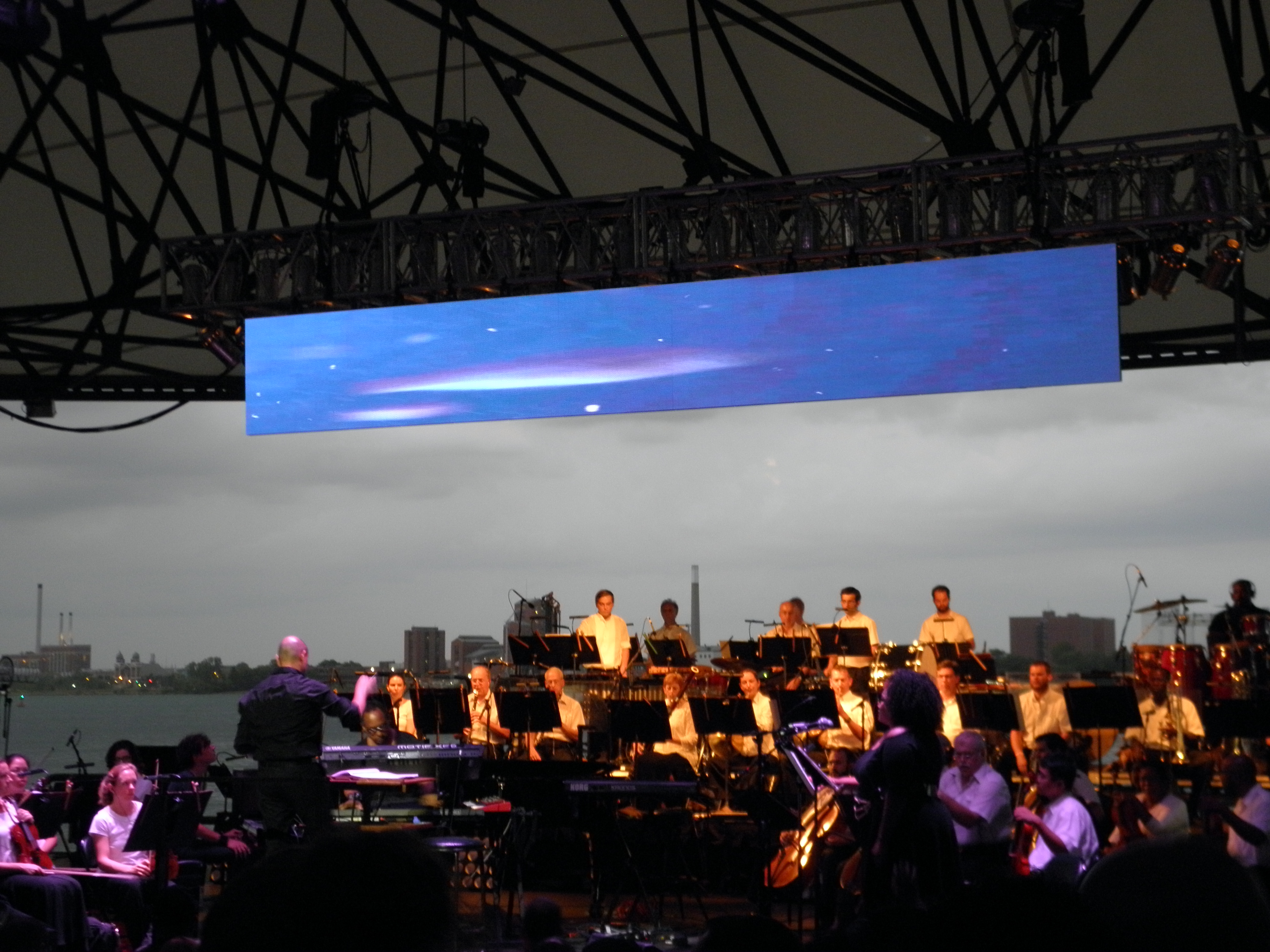
Dzijan Emin conducts the Detroit Symphony Orchestra with Derrick May & Franceso Tristano at Chene Park, Detroit

The people of Detroit love their fellow hometowners who have gone out into the world and done well. The list of successful artists and entrepreneurs is long, and it seems like every time I turn around I learn some famous person is also from the city, or at least nearby.

Derrick May is one of the famous people from Detroit. He, along with a trio of friends know as the Belleville Three, created a musical sensation known the world-over as Techno. That was almost thirty years ago. Derrick’s first releases are now considered classics, the most revered is a track called Strings of Life.

I knew before Derrick before was famous. He was just a guy living down the hall in the apartment building I had moved to in the Cass Corridor. I was just a shy girl fresh out of high school. A mutual friend introduced us and Derrick, being the gregarious personality that he is, invited me over to listen to the music he was making.

One night I went to visit. The apartments in the old building were small. Spread out on the floor of his living room were several little machines and keyboards. A very cool sound unlike anything I had heard filled the room. I really liked it. From an open window I looked out over the night skyline; the city lights were sparse. The music filling the space became haunting as if telling the story of abandonment and decay. The beats began to pulse and urged me to dance. I felt my spirit soaring over the empty lots and empty buildings, and the people who lived out there. I felt a sense of hope.

Derrick said, “Listen to this one I’ve been working on. A friend of mine is playing the piano, I made a loop from a snippet, and I can’t stop listening to it.”

He put on Strings of Life. I loved it.

I left Detroit soon after that, and was unaware of the whirlwind Techno music was throughout Europe. I remember when I first learned Derrick had become famous. It was the mid-90s. I was at a party out in the deserts of New Mexico. A young man was there. Somehow he learned I was from Detroit. He became animated telling me of how much he loved Techno and asked me about a Detroit club called the Music Institute – which was founded before I left the city. Back then Derrick, along with Juan Atkins, Kevin Saunderson, and others, spun in that barebones club.  The young man talking with me just about passed out from excitement when he heard I had danced there, telling me that place was legendary – it was the first Techno club in the world. I felt my ego inflate a bit just because of who I knew and where I had been. Funny how that is. But it is.

On August 14, 2015, Derrick brought his latest project to Detroit – he would play his music with the Detroit Symphony Orchestra at Chene Park. The amphitheater filled with people who shared that same intimate pride I felt back in New Mexico talking with the young man. Only this time the energy of sharing in the glory of success was exponential. And we were not let down. Derrick’s show with the Detroit Symphony Orchestra was epic. History was being made again.

The concert was a magical moment. Strings of Life came from an acoustic piano and created a genre of electronic music, and then an acoustic symphony orchestra played the music that came from Strings of Life, creating a new genre of music – symphonic fusion.

The story of this collaboration has its roots across the Atlantic Ocean. A bold conductor from Macedonia named Dzijan Emin composed several scores of Derrick’s music for classical musicians. The event debuted last year in Macedonia and has played around Europe. I’m so glad it finally made it to Detroit. The sensation of hearing trumpets, clarinets, violins, and drums play what was once synthesizer music was amazing, genius really. And the finale of Strings of Life crescendo-ed the whole concert right out of the park. Everyone was on their feet. It was a celebration of everything we here in Detroit are proud of – innovation, our musical tradition, and someone from our city who goes out into the world and does great things.

###########

here’s a video of one of these concerts: http://concert.arte.tv/fr/derrick-may-ft-francesco-tristano-et-lorchestre-lamoureux-au-weather-festival

Post edited by Christopher Ross. And Michael James is Derrick’s friend who wrote the piano piece.

You can buy my travel memoir, A Blue Moon in China, here

Leave a comment

Filed under Detroit, Essay, Music

One Year Later, June 4, 1989. China

womantiananmen100

That photograph was taken in 1988. It couldn’t be taken today. This post is the epilogue in my memoir, A Blue Moon in China. It’s titled: One Year Later

I watched with the world as tanks rolled through the streets of Beijing. The People’s Liberation Army was ordered to use lethal force to disperse millions of China’s own citizens, unarmed and peacefully assembled – the very people the PLA was sworn to protect. (I learned later that the violence erupted in 70 cities across the country.)

I can’t describe how I felt seeing bloodshed in a city and against a people I had so recently visited and come to know. The knowledge that my peers led the protest was poignant; it touched me deeply. Even now, 25 years later, tears fall from my eyes as I write, my heart breaks.

Over the course of the 55 days that culminated in what China’s citizens call the June Fourth Massacre, people from all walks of life became involved in the protests. University students led the demonstration for democracy, freedom of speech, for freedom of the press, to choose their own job, for higher wages, and against corruption among Party officials; the working person was angry about inflation, loss of jobs, and work conditions.

No one knows how many lives were lost in the cold-blooded suppression. The most common estimate is 2500 people died in Beijing alone, some put the number much higher. Tens of thousands were wounded. The hospitals were overwhelmed. The dead were piled up on the streets and in the morgues. Afterward, thousands were arrested, beaten, and imprisoned. Many of those who formed a workers’ union were immediately executed. With the help of unsung heroes who risked their lives, many of the student leaders and intellectuals on the government’s “most wanted” list managed to escape to foreign lands. They are still there in exile today and have been living abroad now longer than they lived in China.

Leave a comment

Filed under A Blue Moon in China, China, June Fourth Massacre, Tiananmen Square Massacre

Small World, Chapter One from A Blue Moon in China

TowerPageMarch1

The train pulled into the station. Dimly lit lamps dotted a long platform that disappeared into obscurity. The light flickered yellow against a dark sky. In and out of shadows people burdened with big plastic bags stuffed full with everything and then some trudged toward the station door while a grating voice crackled on a loudspeaker. I nestled myself into the thick comfortable cushions in the carriage. Their deep-blue hue enveloped me – dark, cocoon-like, safe. I was in no hurry to move; it was slowly sinking in where my tangents had led me: China.

Why in the world China?

I remembered standing as a young girl under the tall pine tree that towered over our colonial brick house and staring down at the dark, rich soil, imagining a hole tunneling right through to the other side of the world, all the way to China. The pictured passage was tangible to me, as the darkness suggested nothing and everything at once. I remembered putting my hand on the rough bark, letting the pine essence engulf me with the scent of adventure. I felt ready to step into the unknown, to fall like Alice into another world.

Little did I know that moment was a harbinger of this journey I had begun.

What did I know about this land of legend?

I knew China was the land that inspired the venerated old master Lao Tzu to write the meditative canons of the Tao Te Ching, exalting the life-force found in nature, the balance of the yin and yang. I knew China was the birthplace of the scholar Confucius who preached virtuous behavior as the means for social harmony. I knew about the Great Wall, and that there was once a Last Emperor. I grew up wandering the halls of a grand museum with Chinese ink paintings on silk hanging on walls. I saw images of wise sages with long white beards walking with canes down dirt paths on mystical mountainsides. I envisioned porcelain vases with blue dragons, intricate shadow puppets, and scrolls of paper covered in black calligraphy. But this was all a distant observer’s impression of China’s ancient past.

The only information I had of China’s present was the little bit I knew about communism. This was told to me by a beady-eyed retired Marine who wore straight-legged Wrangler jeans and chain-smoked filterless cigarettes. He was an artist now working out of a drafty old warehouse in downtown Detroit, but back before I was born he had been among the first to land in Vietnam, before the public even knew the U.S. had sent troops. His depiction of communism was bleak and insidious. It was scary.

The eerie quiet of the empty carriage told me it was time to leave this safe haven, my last vestige of a connection with the Western world, this train out of Hong Kong. I invoked the calming image of water flowing around a rock, smoothing rough edges while the current took it wherever it was going. The serene picture reminded me to surrender to what was before me, to find the path of least resistance around whatever obstacle might be in my way.

And what was in my way right now was that I had no idea where I was going to stay the night.

Confucius says… Good people plan ahead. And here I was in a country whose language I couldn’t read, write, or speak, without any sort of guidebook to show me the way. I was totally clueless what traveling through China would entail. But my travels were always a caprice that landed me… somewhere. I’ve done this before, I reassured myself, and stepped out of the train.

Pollution hung thick in the humid air. I made my way across the now deserted cement platform. My hand gripped the cold metal knob on the glass door leading into the station; I paused and looked at my reflection. The girl staring back at me shook her head: Now what have you gotten yourself into? I shrugged and pulled the heavy door open.

Cigarette smoke enveloped me, stale body odor blasted me, a deafening racket disoriented me.

My mind went blank.

The clamor of the Chinese language bounced off dirty cement surfaces; the discordant notes reverberated inside my skull, rattling my nerves. It was quick and sharp, a high-octave frequency, rising and falling in short syllables, beyond my ability to process. It was a thousand screeching voices vying to be heard. The rush of it all made me dizzy.

An incomprehensible shout over the loudspeaker was followed by a human stampede. Another train was pulling into the station. A surge of people came at me. Hundreds, maybe thousands, swirled around me. I felt I would be swooped up, hurled down a current, out of control, landing at some unknown port. I fought the urge to shut my eyes, wanting to make it all disappear. Nothing in my travels had prepared me for anything like this. A wave of apprehension came over me. I reprimanded myself, What was there to fear? Not knowing the future was the predicament of life. I took a deep breath and let it go, very slowly. I was on the brink of something big, that much I knew.

I stood still and took in my surroundings.

Everyone looked about the same height, neither short, nor tall, with straight black hair that shone blue under the white lights, and dark brown eyes. Their faces appeared stoic, yet set with determination. Gradually I realized something: there was an underlying calm in the midst of the madness. It was palpable.
I was perplexed. Maybe this was the necessary state of mind to maneuver through all these people and their cacophony? A natural juxtaposition to the chaos? Maybe this is why the Taoist philosophy of finding the path of least resistance came into being here?

Another jarring crackle on the loudspeaker snapped my attention back to the moment, to the task at hand, the one I didn’t particularly want to think about, let alone deal with. I had to find some direction, some
information, some sense of what to do; I had to find somewhere to spend the night.

There was no information booth, no reception desk. I looked around at all the signs. Straight lines crossed up and down, side to side, this way and that, their message indecipherable to me. I sent out a prayer for help, wondering if I should just hit the streets.

A man caught my eye. He seemed to be making his way toward me. His stature was distinct from the
multitudes streaming through the station. He stood a head taller than the rest of us and looked bohemian, aristocratic, with poise and ease, not at all like the masses around me. His style of hair was long, below his shoulders, hanging loose and free, swaying with his long strides. When he finally came into full view, he became more singular yet: he was wearing a white linen suit, freshly pressed, and white sneakers. I couldn’t help but see him as an angel, the influence of my mother’s Catholicism rising reflexively in me.

“Do you need help?” he asked, though I had a feeling the answer was obvious. “I am Yang Ling,” he offered his hand in greeting. It was that of an artist: long,tapered. “Please call me Ling.” I wondered if Ling was his first name or his last. I wasn’t sure if I should trust him. I was wary of strangers, being that I was a girl, but Good Samaritans were part of my journey through life, most especially here in the Far East. I first landed in Asia on a bitter-cold March night in Seoul, Korea. I became lost in a maze of alleyways thick with the smoke of charcoal. A young boy was sent out into the frigid air by his two sisters to escort me to the hotel I couldn’t find. In Bangkok, a woman went well out of her way to make sure I found the American Embassy. Neither she, nor the siblings, asked anything of me; they just wanted to be of help. Unsung heroes, my mother would say, and tell me how her parents would feed hobos passing through town in search of work.

I looked into the eyes of the man who stood before me – they exuded kindness. I prayed to my Guardian Angel for protection and took the chance.

I put my hand in his, and smiled, “I need a hotel for the night. I am a student. My name is Elizabeth.” I had learned this was the easiest way to convey I was on a tight budget.

“Please, follow me.” He kept hold of my hand, gentle, yet firm, and turned toward the front entrance. The sea of people parted before us, opening a route straight out of the station and onto the crowded streets of the city of Guangzhou, formerly known as Canton, China.

The night air felt balmy, but smelled slightly noxious. Ling had me almost running to keep up with his long strides. A little wide-eyed, I held his hand tight, still feeling dazed from the psychic assault of the station.

We crossed a wide street, dashing between bicycles, rickshaws, buses, trucks, and pedestrians. Ling kept us moving at a quick pace. A few blocks later he stopped in front of a three-story brick building. It looked shabby – a good indication I might be able to afford it. Ling held the door open for me. Operatic singing was blaring in the background. The mournful cry of the singer sounded like a dreadful shriek to my ears. I did my best to tune it out.

The man at the front desk was wearing a short-sleeved orange polyester shirt, snug to his body. It was unbuttoned at the top revealing a dingy white tank top. His chest gleamed smooth and hairless. He held a
filterless cigarette between nicotine-stained fingers, and was missing a few of his brownish-yellow teeth. While Ling conversed with the proprietor, I checked out the scene.

The lobby made no pretenses, simply furnished with a well-worn couch and a banged up old coffee table, a couple of floor lamps and the radio. The walls were a sickly hue of pale green. The stench from mounds of crushed cigarettes in several ashtrays filled the room. Even as I stood in a dense cloud of tobacco smoke, I decided the hotel looked clean enough.

“There are no rooms,” Ling informed me. I was puzzled; this didn’t seem like the kind of establishment many people would stay at. “We will go to another, there are many nearby,” he assured me. But then the next hotel was full, and the next. After what felt like hours of going place to place, through alleyways, around dark corners, and across poorly lit streets, my building frustration began to fall into resignation. I didn’t understand what was happening. Wanting to scream, I turned to Ling and asked, as calmly as I could, “Why is everything booked?”

“It is May. The annual Guangzhou Fair is now,” he told me as we came upon a well-lit, busy street. “It is very big. People from all over the world come here to shop goods made in China.” Goods made in China?
I was intrigued; everything in America seemed to be stamped: Hecho en Mexico or Imported from Japan.

Ling led me across a broad boulevard to a hotel with a doorman. My heart sank with futility. It was obviously way beyond my means. But I felt too tired to stop him and allowed myself to be escorted inside as the likelihood of returning to the train station to bed down on a cold, hard bench began to weigh heavy over my psyche.

The lobby was serene, beautiful. Classical music played softly in the background. The crystal chandelier lighting the room sparkled. Under it was a round table topped with polished white marble that had red, black, and gray lines running through it. A large bouquet of fresh flowers created an ambiance of lavish welcome. Everywhere I looked there was opulence and elegance accented in marble, dark wood, brocade drapes, and more fresh flowers.

Ling conferred with the clerk, who looked me up and down with disdain. I felt embarrassed. I was wearing my favorite purple sweatshirt, threadbare and full of holes. My long brown hair was in its usual tangle, pulled back into a ponytail. I wore a pair of dirty blue jeans and dirty white sneakers. Hanging off my shoulder was a school-sized purple and pink backpack bursting at the seams, and quite grungy from the months of traveling afar. I had four hundred dollars to my name, and no means of getting any more. It probably cost half that much to stay one night in this dazzling fantasy before my weary eyes.

The good news was the clerk knew where I belonged – a youth hostel for Westerners; the bad news was it was located on the other side of the city.

“Excuse me, please,” a cultured voice came from behind me. I turned around. A middle-aged man wearing a sharp, navy three-piece suit, possibly silk given its sheen, smiled at me. He had a round, sweet face and carried himself like a real gentlemen: refined and graceful. “My name is Vijay. I am here from Fiji for the trade show. I have an extra bed in my room if you are in need for the night.”

Caught off guard, and rather susceptible to poor judgment, I took a step back, gathered the biggest, baddest city girl vibe I could, given that I wasn’t big or bad, and, hand on hip, looked straight into Vijay’s kind eyes, “What do you want in exchange?”

“Nothing,” he promised, with such sincerity I could only trust him. “It is no problem. I am happy to help.”

I went to give Ling a hug of gratitude, but he was gone, my vision in white vanished into the night. He had delivered me to safety; his job was done.

Vijay led the way through the elegant hallway. His quiet demeanor was respectful and polite; I was his honored guest and he, my regal host. He held the door open for me to cross the threshold into his room. Inside, heavy brocade drapes in a rich maroon and deep brown hung to the floor, hushing the sounds from the world outside. A plush beige carpet gave the space a sense of light, while still more fresh flowers continued to extend a welcoming invitation and sweeten the air with fragrance. True to his word there was an extra single bed. And a marble bathroom! Immediately I took a shower, relishing the strong pressure of the hot water, and the rose-scented soap, such a change from what I had become used to. It was blissful. As I lathered off the grime from the gritty city air, I questioned why I was wandering aimlessly through Asia rather than focusing on a life purpose – Why was I pinching pennies rather than amassing wealth so I could live this sort of life?

Too tired to answer myself, I snuggled in under the comfortable blankets, glorying in the fresh scent that enveloped me. My heart was full of gratitude as the cool, crisp linen sheets caressed my clean skin. It was luxurious. I fell into a deep sleep.

*****************************************

A Blue Moon in China  is the true story of the two months I traveled through China in 1988 when I was 21 years old. I went alone with $400 in my pocket. There are 18 black and white photographs in the book; an index; and recommended reading, movies, and music from the book lists. I hand-drew the map.
Buy my Book links herebluemoonsm300

Leave a comment

Filed under 1988, A Blue Moon in China, China

Detroit, Chapter Two, A Blue Moon in China

detroitrencenadjusted

Detroit 1987

A Blue Moon in China

Chapter Two

Detroit

It had been easy to pack my bag and leave my hometown behind. I had already lived in nine different homes, in two different countries, and in three different states. I had gone to nine different schools. I had two fathers; one who was deceased. And, I felt born with the apparent inability to commit to the status quo.

My mother was from a small French settlement in Michigan. Her ethics were soundly Mid-Western. Her father had been born and raised in a log cabin. He left home at 18 to work in a factory building cars: 14 hour days standing, six days a week, no vacation, no benefits. My grandmother gave birth fifteen times. Of the twelve who survived, my mother was the second youngest.

As a young woman, my mother made her great escape to California and met my Mexican father on a blind date. When I was four he moved us all – my pregnant mother, my two-year old sister, and me – from Los Angeles to Mexico City.

The fates warned me early on not to become complacent and feel too settled: less than a year after we moved to Mexico, my father caught a cold and never got out of bed again. Etched into my memory is the white sundress patterned with bright red strawberries and green leaves that I wore the last time I saw him alive.

My mother moved us back to Michigan, and fared well on another blind date, marrying a disciplined man of Polish descent. His example was a devout sense of right and wrong, coupled with an unwavering commitment to helping the less fortunate.

Thus twists and turns brought me a new father, and to a new city: Detroit. I came of age there neither black nor white, rich nor poor, growing up on the Detroit side of Mack Avenue – “across the tracks” from the affluent who had ensconced themselves along the water’s edge in Grosse Pointe, and next door to those who struggled to make ends meet.

Detroit had experienced many incarnations since the French built a settlement along the strait in 1701. Fur trading came first for the settlers, then lumber gave the few their fortune.

With the rise of riches came world-renowned architects who designed beautiful buildings with complex stone lineaments and ornamental sculptures gracing exteriors. Grand lobbies boasted ceilings of carved wood, stamped copper, and murals of pictures or geometric patterns. Byzantine deco gave splendor to the landscape with colorful mosaics accented in gold and leaded glass windows in harlequin design, glistening in sunlight. The proliferation of theatres, museums, libraries, and universities gave evidence of the city’s burgeoning wealth. Doorman in white gloves once held open glass doors with polished brass handles for women in furs who walked red carpets to shop. The city was known as the Paris of the Midwest.

Diego Rivera was given the four walls of a cavernous room to do with what he pleased. Many were insulted by the political and religious overtones of his work. A favorite urban legend my mother would tell was how Henry Ford’s only son stood guard, rifle in hand, protecting the priceless murals from anti-communist madmen and religious fanatics threatened by the pictures painted into plaster. The legend wasn’t true, though Edsel Ford did issue a proclamation to leave the murals alone. It worked. They were saved.

Profound impacts upon the world at large emanated from the city. The assembly line spewed out automobiles, and Detroit became the Motor City. Unions for workers finally formed after years of struggle, riots, and strikes. Detroit stood proud as the Arsenal of Democracy during World War II as an army of Rosie the Riveters built big bomber planes. Blacks emigrated from the South, and with them came their music, and from the music came Motown.

Soon though, whole neighborhoods were wiped out for freeways. Racial tensions erupted into riots in ‘43 and ‘67, exacerbating the “White Flight” to the suburbs. In the ‘60s, Rosa Parks relocated to Detroit; Martin Luther King, Jr. first gave his “I have a Dream…” speech there, and Malcolm X was known as Detroit Red. The crash of the economy in the early ‘70s drastically downsized factories. Jobs were lost and the population dwindled further.

In the last decades of the 20th century Detroit had become a desolate wasteland: tumbleweeds blew across the wide boulevards as nature reclaimed vacant lots. Drug addicts and the homeless found shelter from the bitter winter wind within the crumbling walls of long-abandoned Victorian mansions. The city became a free zone – as long as you weren’t shooting someone the cops left you alone. Expansive freedom was found in the anarchy, and creativity flourished. Die-hard hippies planted community gardens, weeding out used heroin needles and painting bright murals to ward off despair. Musicians played on discarded engine parts that filled venues with the odor of gasoline. A new dance music, soon to be known as Techno, was being created on keyboards spread out in rooms overlooking the city’s ruins. My own creative expression was to walk the deserted streets and to discover beauty in the decay. I collected stained glass from a burned out church and trudged across fields of tall grass searching for treasure, artifacts of a prosperity long gone.

I loved the city. It was fascinating how affluent culture and ghetto poverty stood side by side, yet a world apart. But I found myself questioning the incongruity of the haves and have-nots. I was disappointed by the imbalance between those concerned with the welfare of people and the much larger group preoccupied with Wrestlemania. I wanted to seek out a world beyond these paradoxes. And far away from heartbreak.

Thus, a year before I stepped off the train in Guangzhou, China, I boarded a train in Windsor, Canada, on the south side of the river from Detroit.

Across Canada I went, figuring out along the way what to do next. It was simple – the train would drop me off in some small town, and friendly people would direct me to shelter. Not much happens in Canada to be afraid of: it’s a land of prairies and plains where people with guns go hunting for food rather than for revenge as so many did in the United States. I hitched a ride through the magnificent Canadian Rockies, singing the songs of Vera Lynn with a family from Scotland. I touched the cold Pacific waters off the Vancouver shoreline, and bid my new friends farewell.

A bus took me back across the border, and to my mother’s sister in Seattle. I “relative-hopped” down the West Coast, from the Michigan side of my family to the Mexican. I crossed the Golden Gate Bridge and played chess with hippies. I learned about political prisoners and drank my first cappuccino. I made my way down the coast to the Los Angeles basin, the land where I was born.

Los Angeles constantly showed itself to be too varied and spread out to pin down in a singular description. The air was fresh by the sparkling ocean, and smelled of urine downtown. The city boasted every demographic, but the mansions of Beverly Hills were another world from the soul food of Compton. It was a city of palm trees with blue skies offering the world in success and Skid Row in failure.

From there it was onward to Arizona and the deserts of the Southwest. My grandmother was up from Mexico, living with my aunt and uncle who welcomed me into their home; it was a moment to be seized.

I fell in love with the desert, the monsoons, the zigzag lightning strikes shooting down one after another, and the boom of thunder. I loved how the rain would approach from the horizon, how the long dark silver brushstrokes descended at an angle from a line of gray clouds. The storms struck in torrents, flooding the parched land. After they passed, the air was pungent with the sweet scent of sage.

I rode a blue 1950s bicycle across that desert full of cacti hundreds of years old to a community college out on the Pima Indian Reservation. I studied. I painted. I contemplated the atom, and looked up at the stars. I was exposed to New Age philosophy, full of glamour and promise, and its credo of creative visualization. I learned about medicine women, the Age of Aquarius, and that the Mayan’s calendar was coming full circle to an apparent end. I read Native American lore about the Great Purification soon to wipe the slate of the world’s sins clean. I began to feel scared and apathetic. I felt the end was near. I wondered what the point was… of anything. I pondered fate, destiny, and how free will fit into the puzzle of life.

Then one day my art professor told the class of the annual trip he had been taking to Bali for the last 20 years. I was intrigued by the prospect of worlds unknown to me. I decided if he could do it, I could do it.

The adventure that had brought me to Arizona had begun with an urge to head west. It was a desire to find my roots, and to seek the answer to the meaning of life. But thus far my transcontinental introspection had yielded few answers. I wrestled with purpose. I felt lazy. I didn’t want to be pinned down by society’s – or anybody’s – expectations of me. But I didn’t have any tangible expectations for myself. I wanted to expand my paradigms. I wanted to be justified in my romantic notions. I wanted to feel magic, breathe in Spirit, see God in everything.

I knew I was one of the few very privileged people in the world; I was well fed, I was educated, I was an American. I enjoyed freedoms most people can hardly dream of, freedoms I often took for granted. I felt blessed to be in a position of choice. I believed there was more to life than getting a job, getting married, and having kids. I just didn’t know what.

So, on that epic sunshine day, staring out the classroom window at the desert horizon and listening to tales of faraway lands, it may well have been an existential crisis I was experiencing – a crisis of my place in the world, that led my to where I now stood: China

****************************************************************************************************************************************

A Blue Moon in China  There are 18 black and white photographs; an index; and recommended reading, movies, and music from the book lists. I hand-drew the map.
Buy My Book links here

Author’s Note:  I grew up with the urban legend that Edsel Ford stood guard with a rifle protecting Diego Rivera’s murals, thus saving them.  Neither my editor nor I could find substantial evidence for it’s truth. I insisted it remain in the story as it was part of my psyche. I have learned since that it was workers from the factories, the very men depicted by Diego Rivera in his masterpiece, who stood guard protecting “… the priceless murals from anti-communist madmen and religious fanatics threatened by the pictures painted into plaster.” I give love and gratitude to them as well. A Blue Moon in China is my just released memoir about the two months I traveled through China in 1988. I went alone with $400 in my pocket…

bluemoonsm300

Leave a comment

Filed under A Blue Moon in China, Detroit

Four Pictures of China 1988 (taken by me)

These are the first four images of China I have released, other than my pictures of the Great Wall which I figure most people who have been to China have taken. I made mini-posters with them for the promotion of my book, A Blue Moon in China; I also wanted to share them on their own without logos and quotes.

A Bamboo Bridge across the Mekong. Xishuangbanna, China. 1988. photo by Elizabeth Pilar

Bamboo Bridge across the Mekong River. Xishuangbanna, China 1988. photo by Elizabeth Pilar

menontrain

Traveling by Train. China, 1988. photo by Elizabeth Pilar

oldwomanorangewall

Woman in Mao suit. China, 1988. photo by Elizabeth Pilar

oldwomanwithumbrella

Woman selling Nuts. China, 1988. photo by Elizabeth Pilar

Buy A Blue Moon in China links here

Leave a comment

Filed under Uncategorized

There is nothing like Good Press, especially from the Library Journal.

A Blue Moon in ChinaPilar’s memoir of her trip through China as a 21-year-old is a look back at a very different country and a barely remembered manner of travel. In 1988, travelers could not use the web to check reviews on youth hostels and restaurants, sightseeing spots, or train schedules. Google Earth was not around to provide a close-up look at destinations, and no one was carrying a smartphone to make the journey easier. In 1988, Pilar hopped on a train from Hong Kong into China with no guidebook or language skills and no idea what was ahead of her. On her journey of self-discovery, Pilar learns about herself as she wanders through China, forming connections with trekkers from around the world and with the Chinese people she meets. Based on Pilar’s journal entries, the reconstructed conversations are creative and add life to her tale. One year before Tiananmen Square, China in 1988 is in the midst of change, and Pilar reflects the conflict of some of the people she encounters.
Verdict This title is a nice addition to women’s studies readings as it chronicles the kind of travel undertaken with a tattered map and the recommendations of students met on trains.Library Journal*

* I kept the reviewer’s name private as this is a subscription-only periodical with librarians and academics in mind.

A Blue Moon in China

If you want to read my story, I’d love for you to order it from an local bookstore and ask your library to add it to their collection.

Softcover: $18.99.   ISBN:  978-0-9904251-9-9

there are 18 black and white photographs I took while there, an index, recommended reading, movies, and music from the book. I hand-drew the map.

Leave a comment

Filed under A Blue Moon in China, China, June Fourth Massacre

Map of my trip through China

maptry777

hand-drawn map by elizabeth pilar 2014

Chronology:

A comfortable train out of Hong Kong into the port city of Guangzhou. From there the journey through the mainland began with an overnight boat ride up the Yi River and all day on a local bus across to Yangshuo. Departure was in early morning on a different boat to arrive in Guilin by the early afternoon. The first train adventure begins – and defines hard-seat-style – going west across the south via Guiyang to the city of Kunming in the providence called Yunnan. It took over 48 hours to arrive. Buses became the mode of travel for the next round of movement. Three days local-style to go further south to Jinghong and the Autonomous Region of Xishuangbanna. And back. Another two buses to Lijiang located in the foothills of the Himalayans Mountains. A couple more to another destination and back. The final bus ride was ten hours to a train station… somewhere. The second train adventure began with an overnight north to Chengdu, and 12 hours more to the city of Chongqing on the shores of the Yangtze River. Three days on a boat down to Wuhan. Less than 24 hours on a train north to Beijing. An overnight back down to Guangzhou. And then outward to Hong Kong.

A good way to look at the landmass of China – it’s slightly bigger than the United States of America.

###

 In the book, there are 18 black and white photographs I took while there; an index; and recommended reading, movies, and music from the book lists. I hand-drew the map.

Library Journal‘s verdict was that it’s a “nice addition to women’s studies readings as it chronicles the kind of travel undertaken with a tattered map and the recommendations of students met on trains.”

Feel free to contact me: elizabeth@elizabethpilar.com 

Buy A Blue Moon in China links here

Leave a comment

Filed under A Blue Moon in China, China, Writers

Blame it on the Bucket List, Part 3

violin

My violin – fiddle.

Author’s note March 23: I haven’t been practicing; I’ve been out and about.

I’m teaching myself how to play the violin. I’m channeling Beethoven and Mozart, Mahler and Americana. I really like to play Irish folk tunes again and again as fast as I can.

I first decided I wanted to learn in 1999. It seemed an ominous time and having a skill that brings music to a table might garner a person some food. I blame Prince: “Mommy, why does everyone have a bomb?” I figured we were doomed one way or another. I started late picking up an instrument, but at least I picked one easy to pick-up – carry, that is.

At the time some of my best friends were musicians. As I struggled to sound tolerable, they would say, “Why did you pick the hardest instrument to learn?” I blamed Sherlock Holmes, BBC, Sir Arthur Conan Doyle. It started with them. And Jeremy Brett. I saw the stage production in London before the television series, which I watched every Sunday night and mourned the day it was done. I read the complete works to satisfy my craving. I decided to add a soundtrack. I went to the local music store and a nice man helped chose my violin. It came with a hard case. He gave the name of someone to take lessons with and so I began. For a few months, anyway.

I picked it up again seven years ago, in conjunction with my bucket list obsession. I decided to learn the fiddle, took a few lessons and drank a few Guinness. The two went well together. But I didn’t have the privacy I needed to sound awful. To my dismay, I felt too embarrassed to practice in earshot of neighbors and set the instrument down, again.

Then I moved in a house with a yard. I had space. No one could hear me and if they did this was a neighborhood of kids, so I could just be one of them. A kid I knew had just picked up the violin. Lucky girl, band was part of her required curriculum in grade school. As far as I was concerned she and I were on par in accomplishment and I wanted to someday play a duet. I heard that she was practicing without having to be told. Knowing that motivated me. (As did the discovery of – wait for it – the new Sherlock Holmes. Oh, how that satisfies many cravings all at once. Benedict Cumberbatch and Martin Freeman you rock my world.)

I disciplined myself for 20 minutes a day. It was frustrating. There were times I wanted to smash my precious instrument.

A professional said to me, “Practice your scales.” An opera singer told me it was all about consistency and muscle memory.

I persevered. I practiced my scales. I played songs over and over. I kept my eyes on the digital tuner. I watched videos generously posted by master players. I tried different holding positions, practiced half hour sessions; I began to sound better.

One day, I sounded good. For real good. It was magic. It came and went, but was staying longer. I was so excited I played for an hour and didn’t even notice. I did this again and again for weeks. I began to pay attention. I asked, “What was I doing different when I sounded good to when I sounded bad? Why was it still hit and miss on the intonation? The bowing?”

I realized it was about not thinking, just listening, deep breaths in and out, totally relaxing and allowing my body to move however it wants. It was about communicating freely. Having fun. I played for an hour and a half every night, still practicing my scales, the playing the same songs over and over, and expanding my repertoire. Two hours at a time. And counting.

Maybe the next thing on my bucket list should be, instead of learning Spanish, go to a pub in Ireland and join in the music around a fire. Then onward to Spain.

###

http://en.wikipedia.org/wiki/Jeremy_Brett      (I loved David Burke, too)

http://en.wikipedia.org/wiki/Sherlock_Holmes

http://en.wikipedia.org/wiki/Arthur_Conan_Doyle

In my book, A Blue Moon in China, there are 18 black and white photographs I took while there; an index; and recommended reading, movies, and music from the book lists. I hand-drew the map. Library Journal‘s verdict was that it’s a “nice addition to women’s studies readings as it chronicles the kind of travel undertaken with a tattered map and the recommendations of students met on trains.” Feel free to contact me: elizabeth@elizabethpilar.com  My website has lots of pictures: elizabethpilar.com If you want to read my story, I’d love for you to order it from your local bookstore and ask your library to add it to their collection. $18.99 softcover ISBN: 978-0-9904251-9-9

Leave a comment

Filed under Bucket List, Essay, learning to play the violin - fiddle, Music, Writers

Reproductions of Six Antique Engravings of China

Show-room of a Lantern Merchant at Peking

Show-room of a Lantern Merchant at Peking

Harbor of Hong Kong

Harbor of Hong Kong

The Great Wall of China

The Great Wall of China

A Street in Canton

A Street in Canton

Gardens of the Imperial Palace, Peking

Gardens of the Imperial Palace, Peking

Porcelain Tower, Nanking

Porcelain Tower, Nanking

All six were drawn by T. Allorn. Each had a different engraver: F. F. Walker, S. Bradshaw, J. Sand, W. H. Capone, J. B. Allen, H. Adler, in that order down from top. (I linked all the pictures to my website and uploaded bigger images of pictures.)

In my book A Blue Moon in China, there are 18 black and white photographs I took while there; an index; and recommended reading, movies, and music from the book lists. I hand-drew the map. Library Journal‘s verdict was that it’s a “nice addition to women’s studies readings as it chronicles the kind of travel undertaken with a tattered map and the recommendations of students met on trains.” Feel free to contact me: elizabeth@elizabethpilar.com  My website has lots of pictures: elizabethpilar.com If you want to read my story, I’d love for you to order it from your local bookstore and ask your library to add it to their collection. $18.99 softcover ISBN: 978-0-9904251-9-9

Leave a comment

Filed under A Blue Moon in China, Bucket List, China

Blame it on the Bucket List, Part 2

OLYMPUS DIGITAL CAMERA

Five novels by Pearl S. Buck & three by Carlos Castaneda

When I saw my partner on the floor and realized he had had a stroke, the strangest thing happened: it was that my life that passed before my eyes; my mortality stared back at me.

The awareness of death lingers as a constant deep in my consciousness. It’s part of my being. I hear Don Juan tell Carlos Castaneda that Death hovered behind his left shoulder and would tap, “It’s Time.” My mother would say that on the day you are born, the day you are to die is already written. These concepts felt ethereal. The picture before my eyes of the fallen man with drool on his chin was tangible, tactile.

I sat in silence next to my partner who lay in a hospital bed. I heard a voice tell me I had to make a “bucket list.” It sounded so cliche. I blamed Jack Nicholson. I didn’t see the movie, but I was living in L.A. and the promotional campaign was everywhere. The jargon stuck, as did the concept which I understood as “the doing for the sake of doing.” Like “art for art’s sake.” Something bourgeois, self-serving.

Concrete passion had a habit of eluding me. I didn’t feel the purposeful drive people who accomplish a lot have. I know people of that caliber, women in particular. I am in awe of them, often wish I was like them, but I am more a person behind the scenes, wanting to be in the shadows. I felt my purpose was to to be of service, in whatever way I could. Or I was before I asked myself that question. I went for walks, read books and wrote in my journal.

That was enough. Until…

“What do I want to accomplish before I die?”

The answer was immediate: write the story of the two months I traveled through Communist China in 1988. I would call it an epiphany, but I had already attempted it over the years. I had three sets of typed sheets of paper, word for word from my journal, done on an electric typewriter and a manual one.

Watching the green lights monitor my companion’s heartbeat, I determined to make it a story. It was a journal written by a young woman of 21 years who studied fine art, not creative writing. (Years later I would read Writing down the Bones by Natalie Goldberg scribble into notebooks stream of consciousness.**)

I began in earnest, fired up for the first time in a long time with a burning desire to complete a long term goal. I figured if that answer was so immediate it must be “my bliss.” I blamed Joseph Campbell for making me want to “follow my bliss.” (And Bill Moyers for interviewing him and introducing him to me.) I did like to draw with pastels, oil sticks, crayons, charcoal, pencils on paper, but that wasn’t the answer that came to me. It was the story of my traveling through China. I didn’t know why it was so important, one doesn’t need to when it’s a matter of the bucket list. It just is important for no reason.

My personality began to change. I became mono-focused, obsessed, impatient, totally self-centered. A Narcissist I think is the word.

A few months later was my 40th birthday. I celebrated on the equator in an eco-cabin high on a cliff. The windows were wide, without screens or glass. There was ocean as far as the eye could see. The royal blue canvas could be zippered close for when the monsoons blew in. And they did.

I had with me my first black spiral bound manuscript and several pencils. I read what was written out loud, protected from embarrassment by the surf pounding against the rocky shoreline, and the company of friends.

I also had with me what would turn out to be the first book I read related to my story: The Good Earth by Pearl S. Buck. I bought it in the airport. I knew her name from the old hardcovers on a shelf of my mother’s. Their presence during my childhood may have one of two subtle conditioning toward my desire to know China. The other were wall plaques my mother bought on a trip to San Francisco just before I was born.On each was a reproduction of a watercolor engravings of a scene in China at the turn of the century. The time of Pearl S. Buck’s stories. The pictures were dark, one had to stand close to study the details, to peer into the past. For my mother they were a treasure, a souvenir purchase from a fancy department store. She hung them in every house we lived in, usually in the kitchen – her domain. For me, they were haunting. They spoke of a foreign land, a time that had stood still. (Little did I know what was really going on in China in the early 1900s, but that information came years later when I chanced upon another old hardback by Pearl S. Buck titled: The Man Who Changed China, The Story of Sun Yat-sen.)**

My partner made a stellar recovery and I stayed on task with finishing my book. (Little did I know it would take seven years.)  I had a story to go with my mother’s plaques.

The next thing on my list: learning to play the fiddle. (How is that for bourgeois?) I’ve been practicing for six months steady. Now that I’m finally sounding better I can feel a mono-focused passion coming in again: all I want to do is play my violin.

###

Each pictures was done by a different engraver: Samuel Bradshaw, F.F. Walker, W.H. Capone, J.Sand, J.B.Allen, H. Adler. All were drawn by T. Allons.

*Any skill I might have writing can be attributed to one man: Christopher Ross, my editor extraordinaire.

In my book, there are 18 black and white photographs I took while there; an index; and recommended reading, movies, and music from the book lists. I hand-drew the map. Library Journal‘s verdict was that it’s a “nice addition to women’s studies readings as it chronicles the kind of travel undertaken with a tattered map and the recommendations of students met on trains.” Feel free to contact me: elizabeth@elizabethpilar.com  My website has lots of pictures: elizabethpilar.com If you want to read my story, I’d love for you to order it from your local bookstore and ask your library to add it to their collection. $18.99 softcover ISBN: 978-0-9904251-9-9

Leave a comment

Filed under A Blue Moon in China, Birthday, Bucket List, China, Essay, Music, Writers

Blame it on the Bucket List, Part 1

My cell phone rang. I didn’t recognize the number. I answered anyway. To my surprise it was a friend of my friend’s, a respected artist known by the name, Wisdom. I was jarred, immediately on alert. Wisdom told me he’s not one for drama, “Normally I wouldn’t call… but Keith and I were talking on the phone and he stopped making sense.”

I grabbed my bag and shouted I had an emergency and bolted to my car. My speed was hampered by the winding mountain road – and by the four door sedan I was driving. The drive felt like forever and a second. I pulled up and braked so hard, the tires skidded on the gravel. I jumped out and ran for the door.

The heat of the day was searing and dry. The sun was bright overhead.  The house looked foreboding. I was afraid to look inside.

I entered the room. It was dark.  And quiet. The usual noise of television was missing.

In the shadows I saw him. He was on the floor leaning up against the bed. His legs were straight out, his torso tilted to the right. Drool pooled up in the folds of his faded flannel shirt. But it was his eyes that caught me by surprise – they were full of mischief. He saw me and said, “Hi. I fell. I can’t get up.”

I ran next door for help. I was in luck, he was hanging out with his friend, a paramedic. He took over, asking the questions that are now so routine for treating strokes.  “What time is it?” he asked. Keith blurted out, “333.” That was his favorite number. The paramedic shot me a very concerned look, it was noon. I sighed relief, somewhere his consciousness, the purity of his being, was there. I studied his face; it was glowing with innocence, the bright-eyed look of the Fool.

The ambulance roared him away. I followed behind wondering what this next bit in my life was going to look like in my life, as my hair whipped in the sharp wind as I sped down the highway. The temperature must have been 100.

I felt calm as I crossed the parking lot toward the overhang of the emergency room entrance. This was a familiar sight for me, part of the landscape – my mother worked as a medical technition drawing and analyzing blood. I grew up walking through the automatic glass doors opening wide, into the bright lights, past the receptionists, straight to behind the scenes like I ownded the place. And this time I was ready for a battle. I knew he couldn’t stay, he didn’t have health insurance.

The air-conditioning was a relief. The attendants asked me questions. I said I don’t know and kept walking.  I went through a swinging gray door. Straight ahead the grey-blue privacy curtain around Keith’s bed was open. The drab neutrality was soothing.

Keith was sitting upright, his legs rocking back and forth freely like a child. His bare chest hooked up to machines. His arms punctured by IVs.

I walked to the cold metal railing and stood beside him. He was beaming. A glow was literally coming from his entire being. He looked like a new born baby who delighted in just being.

“I want to go home. I’m all better.”

“If you can get up and walk out of here, I’ll drive you home.”

Curiosity replaced anxiety, I wanted to see how he would handle this particular crisis in his lifetime of physical ailments.

I went to get a nurse to free him from wires and needles. A nurse came over, I explained. She shook her head with a sad expression, she understood and didn’t like it was that way.

My companion swung his legs around, put on his pants, shoes. He pulled his shirt on as he stumbled, with focus, out of the room, bolting for the door.

I thanked the nurse and ran to catch up. I felt surprised and not surprised.

He was already out the second glass door and turning toward the parking lot by the time I went past the attendants. They shouted at me for his billing information. I shrugged and pointed and said, “I’m sorry but I have to go.”

As soon as we got home, he laid face down on the bed and said, “I’m just going to go to sleep now.” I told him okay and went outside to call in reinforcements, convincing him to go to the VA. I knew they would take care of him. He was a Marine.

Leave a comment

Filed under Essay, Men, Relationship, Women

There is No Such Thing as Bad Press.

PWreview

My first review in print.

It is in one of the big periodicals, Publisher’s Weekly, a journal that goes out to librarians so it is quite an honor to have ink in that publication. And a picture of the cover online. I am a debut author being published by an independent publishing company; it’s a slight chance to even be given a glance. (Thank you PW for taking the time and giving me some notice.)

A friend read the review to me over the phone.

I am in awe of the people of China, their longevity and contributions to civilization; their tenacity and bravery. I know there is a deep pride and love for their country. In a way, they have been celebrating their release from foreign rule since 1900. For a country with a continuous history since the first days of agriculture and a long list of inventions, less than a 150 years is hardly any time at all. It has been a century plus of tumult, to be sure. But there is something special in way of connection for a person born in China to China, an identity, a knowing who they are, a place where their spirit feels at home. I venture to guess that every dissident that has been exiled yearns to return to their homeland. My heart goes out to my Chinese peers, those who ran for their lives after the June Fourth Incident, those who haven’t been allowed to return, even for a visit, in 25 years.

Everyone I’ve met who has been to China and started studying anything about it, gets hooked in. The subject matter is deep, layers upon layers. It became a passion for me for years. I feel honored to share its history in my story.

http://www.publishersweekly.com/978-0-9904251-9-9

In the book, there are 18 black and white photographs I took while there; an index; and recommended reading, movies, and music from the book lists. I hand-drew the map.

Library Journal‘s verdict was that it’s a “nice addition to women’s studies readings as it chronicles the kind of travel undertaken with a tattered map and the recommendations of students met on trains.”

Feel free to contact me: elizabeth@elizabethpilar.com  My website has lots of pictures: elizabethpilar.com

If you want to read my story, I’d love for you to order it from your local bookstore and ask your library to add it to their collection. $18.99 softcover ISBN: 978-0-9904251-9-9

Leave a comment

Filed under A Blue Moon in China, China

Emel Mathlouthi, Voice of the Arab Spring

em

Emel Mathlouthi

Powerful singing transcends language.

Emel Mathlouthi played the Diego Rivera Room tonight at the Detroit Institute of the Arts. On the website announcing her gig, there was a youtube video. Emel Mathlouthi is on the street in a crowd of people. She’s dressed in a red winter coat. A warm scarf is wrapped around her neck. She’s singing into a microphone, her eyes flicker with fear, but she keeps singing her song – the Arab Spring’s Movement’s song – into a microphone, My Word is Free. It is the first song she put music to with words by someone other than herself. The poem by a friend touched her heart and music flowed. My Word is Free became the anthem for thousands of people protesting the Tunisian regime, and then the Egyptian. Millions all told.

I quickly got dressed and drove down to hear her; I knew it was something special, not to be missed. I arrived just in time.

She began playing the electric guitar and singing in a language I didn’t know. The tone in her voice spoke of the desire for diversity, for freedom, for independence. In my mind’s eye I saw her on a mountainside tending a herd and singing to the sky. Her voice sounded like a prayer.

She introduced the next song, “It’s my favorite song to play on the guitar. I think this is one of the first songs everyone learns when they first pick up the guitar.” She hoped we would like her take on it. I think she’s going to play Stairway to Heaven. She played Smells like Teen Spirit.

She called herself a humanist and wanted to sing a song for the homeless, because “one should always remember the people living on the streets.”

A young man calls out from the audience for the song Hallelujah.
She looked up and said, “You know me.” “I do. I do know you. We met in Cairo.”
“Last year?” she asks. He answers with excitement, “Yes, I drove 400 miles to hear you tonight.”

She launched into Cohen’s song. Big tears streamed down my face. I felt self-conscious, but I hid behind my hair. Her last song was sung in a demanding voice calling out for “Liberte.”

She encouraged a sing-along. I couldn’t understand how she was making the sound she was making so I remained quiet. Others succeeded in mimicking her cry.

She seemed brave and vulnerable at the same time. She sang for everyone’s enlightened human rights. That her first song was Teen Spirit written by a man who would have been my age had he lived made Emel Mathouthi seem young to me. And to know she was the voice of the Arab Spring, her song at the center of a revolution that spanned across the top of Africa, I felt awe and gratitude.

But that’s how it goes, isn’t it? The young lead the way.

Link to the video chosen for DIA’s website: https://www.youtube.com/watch?v=fEkqU2GJ2uw http://en.wikipedia.org/wiki/Arab_Spring

Leave a comment

Filed under Detroit, Friday Night Live at DIA, Music

Orgasms & Bonding: An Academic Paper by me (posted for the fun of it)

OLYMPUS DIGITAL CAMERA
 Is Orgasm Sufficient to Create an Emotional Bond?

    Various experiments with rodents, monkeys, even sheep, have led to a number of speculations about the role the neurotransmitter oxytocin has in pair-bonding, sexual behavior, social memory and support, and stress coping (Neuman, 2008).  Correlating subsequent behavior observed from hormone manipulation from experiments on animals to humans is proving too simplistic.  However, these initial experiments serve as important preliminary evidence into investigating its cause and effect.  The three types of voles (prairie, mountain, and meadow) have two distinct patterns of pair-bonding and of social interactions.  The prairie vole behaves monogamously, while the mountain and meadow voles are promiscuous.  Noting these differences with one species provoked inquiry into why that may be the case.  The difference was determined to be due to the varying degrees of oxytocin present in each subtype: the prairie voles showed higher levels than the other two.  It would make sense that a prairie vole living in wide open plains and vulnerable to predators, would have adapted biologically to favor receptors that facilitate trust and sociability.  It would also follow that to do so in pair-bonds creates micro-clusters of interactions.  For the purposes of this paper, though, the jump from the mating patterns of voles to the prediction of emotional bonding in humans exhibited as partner attachment or social behavior, will be regarded as premature, as the current research into the effects of oxytocin on human behavior is proving to be contradictory.  
    If when the neurotransmitter oxytocin is released into the bloodstream during an orgasm it facilitates an emotional bond or sets the stage for a monogamous pair bond, what is the essential quality of this bond?  It may not be love, per se, though Janice Hiller (2004) does define love as a neurochemical phenomenon, so perhaps it is.  For what is love but a feeling or emotion, and what is a feeling or an emotion but a complex interaction of neurons following a path of least resistance to a receptor ready to precipitate a behavior.  And it is in our behavior that the outward appearance of a bond, or partner attachment (Fisher, 1998), becomes apparent.  
    The neuropeptide oxytocin has entered into mainstream awareness as the potential key for affectionate partner attachment (Fisher, Aron, & Brown, 2006) and positive social interaction  (Campbell, 2010; Neuman, 2004).  Indeed, the observable behavioral changes in voles do indicate this peptide hormone plays a part in pair-bonding and affiliation for social interaction.  Oxytocin, once released into the blood stream, has both a central and a peripheral effect on the human body.  The central effect of oxytocin is that it works as a neuromodulator when this hormone is released through the hypothalamic pun and goes into the limbic regions before entering the brain stem (Landgraf & Neumann, 2004).  Its peripheral effect, stemming from the pituitary gland, acts to stimulate uterine contractions during labor and excretion of breast milk during lactation.  It is partly due to the connection with breast-feeding, and its calming affect on the woman, that has lead researchers speculate on its effects with bonding.  That idea is in line with the hypothesis behind the attachment theory: a bond is formed between a breast-feeding mother and the newborn infant.  Also, there may be a connection with the release of oxytocin and orgasm as studies on humans have shown plasma levels of oxytocin increase during orgasm in men and a high base level of oxytocin for multi-orgasmic women (Burri, Heinrichs, Schedlowski, & Kruger, 2007).  The same study showed that the simple act of hugging produced an increase in plasma oxytocin levels for men, thereby supporting its role facilitating affinity in affectionate bonding.  A world of speculations and postulations has opened up from these observations and correlations, but as we know, this does not mean there is an actual causal relationship.  There are inherent limitations preventing definitive conclusions to affirm this effect between oxytocin and pair bonding: we can not simply inject a dose of oxytocin into a human brain as we can into a vole brain.
    According to the Affective Primacy Hypothesis (Zajonic, 1980), to form a love bond, the love has to be communicated, i.e., each person has to know it is there.  How is this communicated?  Oxytocin has been shown to have an effect on the ability to trust and create a feeling of empathy (Campbell, 2010) by activating mind-reading abilities (Domes, Heindrichs, Michel, Berger, & Herpetz, 2007).  Indeed the external administration of oxytocin has shown an increase in verbal exchanges among partners, even during an argument (Ditzen, et al. 2009).  Trust and intimacy are interdependent, and the ability to “read” one’s partner to predict their needs is a crucial factor to sustaining a long-term relationship (Neff & Karney, 2005).  There is no doubt that communication styles affect the quality of a relationship or attachment, and knowing that one is loved allows a person to feel secure and relaxed, thereby creating a bond that enables true intimacy.  Cassidy (2001) sums it up by expanding on the definition of trust itself: the sense that the relationship is solid, the awareness of what one actually wants, the trust in oneself, and the trust in the other.  
    A securely attached person embodies these qualities of trust (Ainsworth, 1972). Yet only approximately 60% of the adult population displays this characteristic.  So what about the other 40% of adults who display behaviors of anxious- ambivalence or avoidance?  Does the release of oxytocin during orgasm attenuate these tendencies?  And what about the 20-30% of women who do not experience orgasm (Harris, Cherkas, Kato, Heiman, & Spector, 2008), or men with erectile dysfunction?  Does it follow that neither of these groups form positive emotional bonds?  I should point out that many of the women in the Harris, et al., study were experiencing marital difficulties or were not in a relationship.  This study also revealed a high correlation between emotional instability, demonstrated by high anxiety levels, and the inability to achieve orgasm (Harris, et al. 2008).  Although there are a variety of psychological and physiological factors involved in erectile dysfunction (Levay & Baldwin, 2009), stress and anxiety certainly do play a large role.  If oxytocin is the stress reliever it is reputed to be, then wouldn’t administrating a dose of oxytocin be the answer to these woes?  
    Alvares, Hickie, and Guastella (2010) noted an important component of the desire to be a part of a social circle, and its correspondence to levels of oxytocin: these effects were dependent on the quality of the precipitating social encounter.  When the social cue was encouraging, cooperation ensued after the release of oxytocin into the bloodstream, whereas if there was an element of uncertainty within the context of the quality of social inclusion, the presence of intranasally administrated oxytocin in both men and women did not reduce the state of stress.  This concurs with the idea that human behavior arises from within a psychological context, and that the effects of oxytocin are highly conditional to those psychological states (Hiller, 2004).  
      If patterns of attachment are created when one’s preconceptions from past experience set up paradigms of recurring patterns of behavior, as both Bowley and Ainsworth have proposed, and as many others have noted, then these are the psychological states which may influence the workings of oxytocin on one’s physiology.  In other words, the quality of an attachment is dependent on the expectations a person has before the release of oxytocin, of particular concern here before the orgasm.  The connection between a perceived threat of loss and ensuing anxiety is well known (Bowlby, 1980), and a person who is in a state of constant worry, from fear of rejection or abandonment, is certainly approaching their partner in a state of uncertainty.   
    Taylor, et al. (2008) found high baseline levels of plasma oxytocin in women, both young and old which seemed to correlate specifically to relationship stress.  If the woman was in a partner attachment, this relationship stress was conveyed as a feeling of distance from her partner, of being unable to trust and open up to her partner.  In short, the stressed woman conveyed feelings of anxiety.  There were also indications that these elevated oxytocin levels were shown in women not in a relationship.  Interestingly enough, it was also shown in woman either experiencing estrangement from their mothers or grieving the loss of a pet.  What is not known is whether an influx of oxytocin from an orgasmic release would contribute to a feeling of calm and openness to social connection, as it also not known if these woman were experiencing orgasms or not.  
      If desire is a combination of psychological and physiological responses, particularly for  women (Basson, 2003) (but also for men as evidenced in erectile disfunction studies), then what happens when the psychological precepts are those of anxious-ambivalent attachments or of  avoidant attachments?  Does an orgasm override these tendencies to block secure attachments?  Or does the attachment occur, but then either become manifest in total preoccupation and obsession with the partner or become repressed so as not to be consciously acknowledged?  And further, does gender make a difference?
    The psychological states of mind a person is experiencing, such as those displayed in the attachment theory, may be the key for the subsequent effects oxytocin has on the bond.  The study Birnbaum, Reis, Mikulincer, Gillath, & Orpaz, (2006) conducted reveals some pertinent evidence to support this claim: within the context of a relationship, both men and women demonstrated a decrease in maladaptive behaviors following sexual relations.  The key, though, did seem to be the quality of mindset prior to coitus.  If the mindset was positive, the interactions followed suit, but if it was not, then the opposite was true.  This correlation was most evident in partners who demonstrated anxious attachment tendencies.  In those who were avoidant, their tendency to regard sex as a separate entity continued to be evident (Birnbaum, et al., 2006).   While it can be safely assumed that, unless there was an erectile dysfunction, an orgasm occurred during coitus for the man, what is not known, is whether the women in the study experienced an orgasm during coitus.  According to the statistics gathered by Taylor, et al., only 36% of women are considered to be highly orgasmic, while 16% of women have never had an orgasm.  Granted, this study was geared toward older women- – mean age of respondents was 50, but these statistics may hold true across all age groups.
    Palk (2010) has looked at “state effects” at the time of sexual involvement, and has determined that people self-select into certain relationship types: some for sex, some for love.  His postulation that the quality of a relationship is determined by the mental mindset at the time of sexual involvement reinforces the findings of Alvares, et al. (2010) on oxytocin and subjective responses.  Birnbaum, et al. (2006) suggest that people with avoidant attachment tendencies are more likely to engage in casual sex.  Stinson (2010) has noted that people with secure attachment tendencies do not readily participate in the hook-up culture, and that the avoidant and anxious characteristics of others tend to become more pronounced in that culture.  Faley and Shaver (2000) even go so far as to claim that a relationship does not indicate an attachment.
    Avoidant attachments often work in such a way that no matter what the underlying truth of  the emotion may be, there is a pronounced tendency to deny that truth.  Fisher, et al. (2006) makes the case the sex drive is distinct from both romantic love and partner attachment, therefore a person who is avoidant may engage in sex, even have orgasms, but the act is purely physical; they have detached themselves from any further emotional possibility.  Many studies have shown that highly avoidant people are less likely to fall in love or be interested in long-term relationships, while highly anxious people tend toward using sex to keep their partners from leaving them and yearn to merge with their partner (see Birnbaum, et al. 2006, for full review).
    Oxytocin has been shown to have a direct relationship with estrogen (Taylor, 2006); it needs estrogen to synthesize (Hiller, 2004).  Could this indicate that women are more susceptible to emotional bonding from an orgasm than men are?  Zajonc (1980) has proposed that women use sex as a means of creating bonding.  But does it work?  Do the men they have sex with bond with them?  Since men reach orgasm more frequently than a mere 36% of the time, are they also bonding emotionally with the women they are engaging in sexual relations with?  Hiller (2004) has stated that the oxytocin release for a man does indeed affect a sense of closeness.  The levels of plasmic increase of extraneously administered oxytocin remained high in men for about 80 minutes following their orgasm (Burri, et al. 2007).  This temporary emotional bond, experienced as the oxytocin is circulating through the blood, may simply be the hormone’s calming effect, and not something that creates a sustained secure attachment.  
        I find myself cautious about disregarding the potential effects of oxytocin on emotional bonding, especially for women who display anxious-ambivalent tendencies.  Due to the random occurrence of an orgasm, when it does occur, a woman might mistake the pleasurable feeling to indicate a love for the man.  Unless he can give her the constant reassurance she needs, e.g., he may be an anxious- ambivalent himself and respond in kind, she could find herself at the losing end of an avoidant’s game playing.  Men, in general, are known to play more games than women (Hendrick & Hendrick, 1991).  If a sense of trust is created by the release of oxytocin and the man is experiencing a sense of peace from his own orgasm, the woman may find herself even more vulnerable to rejection than if she had not experienced an orgasm.  She may be at an even greater risk for forming an inappropriate emotional bond, as studies have shown that administered oxytocin decreased fear in situations of betrayal, presumably by decreasing activity in the amygdala (Campbell, 2010).
    Those who are avoidant may have enough autonomy to remain emotionally stable, although if they are intent on using sex as a physical release only (Birnbaum, et al., 2006) with oxytocin’s effect on reducing fear, they may find themselves emotionally attached and in an active fight to resist the intimacy aroused.  And if, as Oberzaucher & Grammer (2009) noted, men tend to overestimate their sense of control in unfamiliar situations, then a relationship that began as a hook-up and then progressed to casual sex (friends with benefits) at the eleventh encounter (Palk, 2010) with reoccurring orgasms with the same person, an avoidant may find themselves experiencing a cognitive dissonance.  That may not lead to a dismal end if their partner is either in a secure attachment pattern, or is another avoidant who understands autonomy and negotiation. This would allow the partners to bond on a cognitive level rather than an emotional one.
    My conclusion is nurture rules the day with regard to how we humans actually do form our attachments, and nature plays a supporting, yet potentially dangerous role depending on one’s true intentions, motives, desires, and needs.  Perhaps what we might now learn from the voles is to be content with different mating patterns, and to know ourselves well enough to self-select into the pattern we want.  Those who have secure attachments may be like the prairie voles, at peace in their pair bonds and social interactions.  Avoidant attachments may be seen in the mountain voles, off on new adventures and seeking out novelty, moving from one vole to another.  Perhaps the meadow voles are caught in the middle and are anxious and ambivalent.  
    The preliminary results concerning the effects of oxytocin released into the blood stream, whether from an orgasm or intranasally, are not straightforward enough to be definite, but what behavior across the spectrum of human nature is?  One thing I have concluded about oxytocin is that it seems it can have a powerful effect, though it may be for only a short period of time. Perhaps if oxytocin is released upon simple affectionate touch, as well as during an orgasm, these intimate caresses may be the key to forming a sustained secure attachment.  I would suggest longitudinal studies could be done to inquire upon this effect.   As far as  emotional bonding occurring, it would seem oxytocin does indeed exert an effect, but the nature of its quality seems to be context-specific.  It does not appear to be as simple injecting oxytocin into the human brain and converting a promiscuous person into a monogamous partner, if that is what one wants.  At least, not yet.

References
Ainsworth, M. D. S., (1972) Attachment and dependency: A comparison. In J. L. Gewirtz (Ed.),     Attachment and dependency, 97-137, Washington, DC: Winston.
Ainsworth, M., Blehar, M., Waters, E., Wall, S., (1978) Patterns of attachment. Hillsdale, NJ:     Erlbaum
Alvares, G., Hickie, I., & Guastella, A. J., (2010) Acute Effects of Intranasal Oxytocin on     Subjective and Behavioral Responses to Social Rejection. Experimental and Clinical     Psychopharmacology Vol. 18, No 4, 316-321. doi: 10.1037/a0019719
Basson, R., (2003) Biopsychosocial models of women’s sexual response: applications to     management of ‘desire disorders’. Sexual and Relationship Therapy, 18, 107-115
Birnbaum, G. E., Reis, H. T., Mikulincer, M., Gillath, O., & Orpaz, A., (2006) When Sex Is     More Than Just Sex: Attachment Orientations, Sexual Experience, and Relationship     Quality. Journal of Personality and Social Psychology, Vol. 91, No. 5, 929-943.
    doi: 10.1037/0022-3514.91.5.929
Bowlby, J., (1980) Attachment and loss: Vol. 3, Loss: sadness and depression. New York: Basic     Books.
Burri, A., Heinrichs, M., Schedlowski, M., & Kruger, T. H. C., (2008) The acute effects of     intranasal oxytocin administration on endocrine and sexual function in males.     Psychoneuroendocrinolgy 33, 591-600. doi: 10.1016/j.psyneuen.2008.01.014
Campbell, A., (2010) Oxytocin and Human Social Behavior. Personality and Social Psychology     Review 14(3), 281-295. doi: 10.1177/1088898310363594
Cassidy, J., (2001) Truth, lies, and intimacy: An attachment perspective. Attachment & Human     Development Vol 3 No 2, 121-155. doi: 10.1080/14616730110058999
Domes, G., Heindrichs, M., Michel, A., Berger, C., & Herpetz, S. C., (2007) Oxytocin improves     “mind-reading” in humans. Biology Psychiatry 61, 731-733
Ditzen, B., Schaer, M., Gabriel, B., Bodenmann, G., von Dawans, B., Turner, R. A., Ehlert, U.     (2009) Intranasal oxytocin increases positive communication and reduces cortisol levels     during couple conflict. Biological Psychiatry, 65, 728-731
Faley R. C., & Shaver, P. R., (2000) Adult Romantic Attachment: Theoretical Developments,     Emerging Controversies, and Unanswered Questions. Review of General Psychology, Vol.     4, No. 2, 132-154. doi: 101037//1089-2680.4.2.132
Fisher, H., (1998) Lust, attraction, and attachment in mammalian reproduction. Human Nature 9,     23-52
Fisher, H. E., Aron, A., & Brown, L. L., (2006) Romantic love: a mammalian brain system for     mate choice. Philosophical Transactions of The Royal Society B, 361, 2173-2186.
    doi: 10.1098/rstb.2006.1938
Harris J., Cherkas, L., Kato, B., Heiman, J., & Spector, T., (2008) Normal Variations in     Personality are Associated with Coital Orgasmic Infrequency in Heterosexual Women: A     Population-Based Study. International Society for Sexual Medicine, 5, 1177-1183,
    doi: 10.1111/j.1743-6109.2008.00800.x
Hendrick, C., Hendrick, S. S., (1991) Dimensions of love: a sociobiological interpretation.     Journal Social Clinical Psychology, 10, 206-230
Hiller, J., (2004) Speculations on the links between feelings, emotions and sexual behavior: are     vasopressin and oxytocin involved? Sexual and Relationship Therapy Vol. 19, No. 4.
    doi: 10.1080/14681990412331297974
Kruger, T. H. C., Schiffer, B., Eikemann, M., Haake, P., Gizewski, E., & Schedlowski, M.,     (2006) Serial neurochemical measurement of cerebrospinal fluid during the human sexual     response cycle. European Journal of Neuroscience, Vol. 24, 3445-3452.
Landgraf, R., Neumann, I. D., (2004) Vasopressin and oxytocin release within the brain: a     dynamic concept of multiple modes of neuropeptide communication. Front.     Neuroendocrinol. 25, 150-176
LeVay, S., Baldwin, J., (2009) Human Sexuality. Sinauer Associates, Sunderland, MA.
Neuman, I. D., (2008) Brain Oxytocin: A Key of Emotional and Social Behaviors in Both     Females and Males. Journal of Neuroendocrinology 20, 858-856.
    doi: 10.1111/j.1365-2826.2008.01726x
Palk, A., (2010) “Hookups,” dating, and relationship quality: Does the type of sexual     involvement matter? Social Science Research 39, 739-753.     
    doi: 10.1016j.ssreseach2010.03.011
Neff, L. A., Karney, B. R., (2005) To Know You Is to Love You: The Implications of Global     Adoration and Specific Accuracy for Marital Relationships. Journal of Personality and     Social Psychology, Vol. 88, No. 3, 480-497. doi: 10.1037/0022-3514.88.3.480
Oberzaucher E., Grammer, K., (2009) Ageing, Mate Preferences and Sexuality: A Mini-    Review. Gerontology 55, 371-378. doi: 10.1159/000203698
Stinson, R. D., (2010) Hooking Up in Young Adulthood: A Review of Factors Influencing the     Sexual Behavior of College Students. Journal of College Student Psychotherapy, 24,     98-115. doi: 10.1080/87568220903558596
Symons, D., (1979) The Evolution of Human Sexuality. New York, Oxford University Press,     1979
Taylor, S. E., Gonzaga, G. C., Klein, L. C., Peifeng, H., Greendale, G. A., Seeman, T. E.,     (2006)     Relation of Oxytocin to Psychological Stress Responses and Hypothalamic- Pituitary     Adrenocortical Axis Activity in Older Women, Psychosomatic Medicine 68, 238-245.
    doi: 10.1097/01.psy.0000203242.95990.74
Zajonc, R. B., (1980) Feeling and thinking: preferences need no inferences. American     Psychology, 35, 151-175

Leave a comment

Filed under From My Archives, Human Sexuality, Men, Relationship, Women

Abstract: Orgasms & Bonding

I wrote an academic paper titled: Orgasms and Bonding for a college course called Human Sexuality.

Here’s the Abstract.

ORGASMS & BONDING

Abstract
My interest in the inquiry into whether orgasm was sufficient to create an emotional bond was sparked during a lecture in which it was declared there was a ‘predictable bond’ between the two events.  As I have not observed this to be the case, particularly within the context of sexual relations outside the parameters of a monogamous relationship, e.g., sex with prostitutes, hook-ups or casual sex (regardless of its duration or frequency), not to mention the frequency with which adultery has been reported to occur, up to 76% for both men and women (Symons, 1979), I began my research.  My aim to substantiate the claim of this predictable bond led me to the neurotransmitter oxytocin.  As I first read the literature, I surprised myself by conceding that the simple answer may well be yes: the release of oxytocin during orgasm showed considerable evidence for creating emotional or pair bonding.  But these claims were primarily deduced from experiments with animals; humans are far more complex creatures, and thus a simple answer of “yes” to this question cannot suffice.  (Though, alas, such simplicity would save some from a lifetime of either yearning for secure attachment or avoiding the possibility thereof.)  This paper looks to examine to what extent the physiological functioning of the human body affects the nature of an emotional bond or attachment, given that there are extenuating factors in play, in particular those of Ainsworth’s (1972) patterns of attachment: secure, anxious-ambivalent, and avoidant.

Leave a comment

Filed under Essay, From My Archives, Human Sexuality, Men, Relationship, Women, Writers

J L Hudson’s in downtown Detroit: a collection of photographs & a little story

detroithudsonsfull hudsons When I was in grade school, my mother would take my little sister, my little brother, and me downtown to shop in the bargain basement of Hudson’s. It was the late 70s and the grand department store had seen better days. What was once celebrated as “the” place to shop was now faded in its glory. The building stood proud, defiant in its claim to fame. We entered the grand hallway and made our way downstairs. It was a bright place with bins full of clothes, shoes, coats, socks, and underwear. It was hot, crowded with women and children talking loudly. The subterranean room smelled of dust and the array of things to buy overwhelmed and confused me. After the ordeal of shopping was over, my mother would treat us to lunch on a floor with a broad view of the Detroit skyline. The old elevator had one of those metal gates that had to be manually pulled open and closed. Inside the restaurant was an aquarium with fish that was a wall between the dining rooms. It dominated the experience for me. There was also a wall of tiles with the design of ocean life and the rug was plush. (I just asked my mother about this memory of mine – she didn’t remember the fish. Was that somewhere else? Anyone know?) Hudson’s was known for its Maurice Salad. The dressing was top secret. (Years later, a lady who worked in the kitchen told me no one was allowed to take home any of the leftover food; it all had to be thrown away. She told me how frustrating and sad it was to see the waste, especially when the people who worked there would have been happy to take it home.) sideofhudsons100sidewithfence100 During Christmas time there was a Santa Claus, ready for his picture to be taken. graffitionhudsons100bookcadillacbuilding100

My mother would reminisce about the days when doorman wore sharp uniforms and would hold open the heavy door. Women ran the elevators. And the many floors were stocked full of quality goods. Hudson’s was known for its window displays and the artfully arranged glass counters.

I never knew that Detroit. Hudson’s closed in ’84. These photos were taken by me in 1988. Scrappers had broken in and stripped the building of all its value. After that there didn’t seem to be any reason for it to take up space, for it to be a blatant and constant reminder of a city fallen on hard times. The building was imploded and the rubble was cleared away, leaving an empty space like a scar upon the city’s landscape. hudsonsandcar100

###

All the photographs were taken by Elizabeth Pilar These photographs were taken upon my arrival back in Detroit after being gone a year. In my book, A Blue Moon in China, there are 18 black and white photographs I took while there; an index; and recommended reading, movies, and music from the book lists. I hand-drew the map. Library Journal‘s verdict was that it’s a “nice addition to women’s studies readings as it chronicles the kind of travel undertaken with a tattered map and the recommendations of students met on trains.” Feel free to contact me: elizabeth@elizabethpilar.com  My website has lots of pictures: elizabethpilar.com If you want to read my story, I’d love for you to order it from your local bookstore and ask your library to add it to their collection. $18.99 softcover ISBN: 978-0-9904251-9-9

Leave a comment

Filed under A Blue Moon in China, Detroit, From My Archives, Photos by me, Writers

A Bit of Fun: My Essay on Eddie Murphy’s RAW

Image

In 1987, Eddie Murphy released his movie, Raw. It was simply the stand-up routine from his most recent tour, but Murphy was at the top of his game in the world: he had become the most successful black entertainer of all time (a title which he still holds to this day.) Although I personally prefer not to see a person as a reflection of the color of his skin, I concede that as an influence of society it has substantial bearing. Eddie Murphy could well be seen as the king of the urban people, or perhaps, more aptly, the tenured jester, secure enough in his position to say it like it is and call out our behaviors for all their absurdities, hypocrisies, and contradictions: our prejudices. It is not a fluke Murphy has the power of our attention, he earned it through command of his talent and genius. He brilliantly conveys profound reflections of society and astute perceptions of relationship dynamics while making us laugh at ourselves. We know he speaks the truth. And no one is safe of his pantomime of stereotypes, he hits every demographic equally, including himself, though with varying degrees of intense potency.

On the surface, the writings of Raw may not feel like an aggressive catharsis, but it is my sense that the underlining motive and drive for Murphy himself is the release of anger and pain from a recently felt heartbreak. The choice of opening the movie with the song, Ain’t Too Proud to Beg, reveals his mindset. It is as though he is using the routine to say to the unknown woman, ‘I offered you everything, I would have rolled over and been your puppy dog if you had treated me right.” He, then, shows us his humble roots with a look into his childhood. He tells us where he came from is as though he is saying, “I am one of you so listen to me.”

The opening sequence sets the stage for his influence to persuade us. He is a god, surrounded by a protective entourage. He makes his entrance as a silhouette revealed into a form exuding sexual prowess. He knows it and uses it; he has our attention: women want him and men want to be him.

Right away he reveals his heart by paying respect to the man who made it possible for him to be where he is today – Richard Pryor. Murphy tells us he is human and didn’t come out of a void. He had a role model, just as he has become ours. So there it is: Murphy is real, not raw, and, then, he tells us what is really on his mind: he almost got married; almost being the operative word.

To give the context for Murphy’s rational to marry in the first place, it is necessary to recall what was happening in America at the time. In the late eighties, two pertinent themes in particular give rise to his tirade and what he claims is his fear. The first is the advent of AIDS into mainstream media awareness. For the two decades prior, popular attitudes toward sex had been opening up. Birth control released women from fear of unwanted pregnancy and drugs like cocaine and poppers created an environment of free-for-all promiscuity. Up until Rock Hudson died from AIDS in 1985, the topic was behind the scenes, among homosexuals, intravenous drug users, and from blood transfusions. Even though he was gay, Hudson’s death brought AIDS to the front cover of People magazine. And Murphy took note. It was time to stop partying and settle down with one woman. “I am a realist,” Murphy states emphatically.

The second major movement was women entering the white collar business world of men; they had been, until then, kept out of the professional world en masse. Now women were educated, ambitious, and successful. In conjunction with this shift, women who had experienced the poor end of the stick after a divorce were turning it about and making sure they were taken care of. Too often they had been left with nothing and no real means to give themselves what they had had financially while married. Herein lies the key to the demise of Murphy’s best laid plans of marriage and monogamy.

And so it begins, Murphy has moved through some good routines imitating Bill Cosby, Richard Pryor, Michael Jackson and an assortment of gay men, making sure we know the man standing before us knows his art while he makes his way to the crux of the matter. “I almost got married last year,” he tells us, and turns to face us with the truth about AIDS as a reality: casual sex is “a game of Russian Roulette.” It becomes about the simple task of finding the ‘right’ woman, someone to take him out of the game. He tells us straight up that she has to be intelligent, which is important enough to him to say twice, as well as pleasing to the eye. Then tells us his nightmare, Johnny Carson’s face on the cover of a magazine with the headline: “Half.” Murphy wants his prenuptial protection from gold diggers; he is afraid of the vindictive nature of women. And rightly so, so we laugh. We see ourselves in his portrayal. We know the perils of love, money and sex mixing, whatever level and dynamic it plays out on.

He beseeches women to be fair, to not be greedy. There is an underlying sense of anger in his tone toward this theme. It is as if his woman refused to sign on the dotted line and it hit him so hard in his heart that he is telling us he offered her the world and it wasn’t enough. His choice of opening song tells us all he wanted was sex, just treat him right. And, Murphy is reeling from the rejection. Murphy knows where women’s attitude is coming from and he is well aware who he is as he tells us, “I’m a target.” His safety net from random death is gone and his success may well be what stands in the way of marriage; he is afraid of divorce. And one could easily deduce that he is not happy about it.

Murphy then brings it “to the ‘hood.” He starts to talk to how women play with men and how easy men are to play with. He starts to talk about women joining in chorus with Janet Jackson’s battle anthem: “What have you done for me lately?” He goes on to call out the games women play. The picture he depicts of women’s motives and behavior is skewed, twisted up, and not flattering. For all his re-enactments of gays, Italians, celebrities, and the common man, his portrayal of women is the most harsh. It is as though he is angry women have ‘the power of the pussy.’ Murphy is relentless in his characterization of the insidious and manipulative nature of women. “Let’s just call it a Pussy Trap,” he says, and warns men not to get caught in it. He reminds men that they can take back control; that women love sex and use it to get what they want. Men can do the same. He tells men as soon as they “make a women come real hard,” the power has flipped. Once they have that, men are free to do what they want: to treat women badly, to be cold and distant, to have other women, basically, to pay women back for all the games they’ve played; all they have to do is say “I’m sorry.” Murphy sets up the new battle of the sexes, but with a warning, treat her right or “she will go out and fuck another man.” He defines the terms for what to look for in a mate: “Find someone just as fucked up as you are and settle down.”

Twenty three years later I ask myself what has been the social influence of this film on a generation of urban men and women and their struggle to relate to each other. What has the effect been on those who considered him an authority? Have these become our new heuristics? The idea that women are bitches out to get what they can from men? That “all men fuck other women,” that they are “low in nature,” and “have to do it, it is a man’s thing.”

I see this paradigm played out today. I see it in the paradigm of being ‘single’ as defined by men: no ring, no commitment. I see it in jaded women who seek revenge for perceived wrong-doings, cathartic in their frustration with aggression. I see it in women who take a defensive stance, possibly out of necessity, to take care of themselves, and to not let anyone run them over. I see it in jaded men, understandably wary of women as women can become a bit crazy. If what Murphy said is true, men resent women who withhold sex, and “he don’t like you anymore, but he still wants to fuck you,” it is no wonder there is anger. For how do we know what is real, or is it all a game? It looks to me like the stereotypes Murphy insightfully offered as a warning became, in fact, a model of behavior, rather than as a mirror of change. Perhaps because he made it funny, we didn’t see it happening. It was all a joke.

What else does Murphy tell us? Its a dangerous world out there for sex. To be careful. He brought the taboo subject of AIDS to the people. Unfortunately, he only preached monogamy and not putting on a condom. Had he done so, maybe more would have listened. For as we know, if it was cool for him, it must be cool for us. Even if we get what he’s saying all backwards and wrong.

I know the influence of Raw for myself. I didn’t want to be the bitch he portrayed. I didn’t want to play games. I struggled with the concept men were “out to get as much pussy as possible.” But, for me, it never felt right to use sex as a weapon or tears as a means of manipulation. (I’m too much of a romantic for that.) I felt Murphy’s pain and agreed with the idea, at least, of a prenuptial. I listened to when he said, “a man’s ego is easy to cater to.” To this day, I adhere to this script given to me by the man who became my ideal for a man, a man who wants to fuck, not make love, for better or for worse. And, yes, I made a note to myself to not be shy, and to eat a steak at dinner.

From the archives: Essay by Elizabeth Pilar

Links to Buy A Blue Moon in China

1 Comment

Filed under Essay, Essay from my Archives, Men, Relationship, Women, Writers

The face of Mao Zedong in a contemporary piece of art. Detroit 2014

Image

Face Recognition by Rick Cronn 2014 (detail)

Seeing Mao’s face shining from an art assemblage was a such surprise I had to share.

I don’t know if artwork like this is allowed to be displayed in China today. I do know that when, in 1989 during the demonstration for the freedom and democracy, three students threw ink on the big portrait of Mao that hangs overlooking Tiananmen Square. They were arrested. One of whom was recently released and, rumor has it, is not right in the head.

Image

Face Recognition by Rick Cronn 2014

The piece is called “Face Recognition” by Rick Cronn. It won first place in the 2014 Silver Medal Exhibition at the Scarab Club in Detroit.

*****************************************

Leave a comment

Filed under Art, China, Detroit, June Fourth Massacre

“Ah – I regret to say I was a completely rebellious child,” Xie Bingying. A Woman Soldier. China 1926

Image

Xie Bingying, Nationalist Army, China 1926

Xie Bingying was a writer, who, once celebrated, was shut out of the homeland she loved, and suffered greatly for.

Born into a small village in China 1906, Xie, was the youngest of five siblings. Her three brothers and only sister were older by almost a decade.  From the moment she was born, her father held her on his chest and he read poetry out loud. She was Precious to her mother.

At an early age Xie had her own idea about how she wanted to be in world – a person with rights.

Her mother tried to beat this useless idea out of her. Yet she held off on Xie’s foot binding until she was eight years old.


“Mama, I do not want my feet bound.”

“It is because I love you that I bind your feet…”

Her mother believed being a woman was being wife, to serve her husband’s family, make sacrifices to the alter of the gods, to give birth to more sons. Confucius said. And to be a wife, Xie’s feet must be bound.

Xie’s father was born to a farmer, but his passion for books led him to be a Scholar, the most respected position in Chinese society. She, too, loved to read, and eventually demanded to go to school, even though the only one in the area was all boys. Xie’s mother had mixed responses to this declaration, and eventually cried out:

“What! A girl thinking about study? Really, then heaven and earth are turning topsy-turvy…”

Xie went on a hunger strike to get her way. She was twelve years old.

The year was 1918. One year later the May Fourth Movement would begin.

ImageFrom the front lines of the Nationalist Northern Expedition, Xie sent letters to a newspaper in Shanghai. The collection, War Dairy, was published in 1928. She published many writings over her long and varied career.

A Women Soldier’s Own Story is the most famous of all her work. She began writing this autobiography when she was in her thirties, and finished it many years later.

Xie, Bingying. A Women Soldier's Own Story: Translated by Lily Chia Brissman & Barry Brissman. New York, NY: Berkley Publishing Group, 2001 http://en.wikipedia.org/wiki/Xie_Bingying


Leave a comment

Filed under China, May Fourth Movement, Women, Writers

My Portable Library

My Portable Library

A few of my books on China – part of my “portable library” I lug to my editor’s for inspiration, and to fact-check what I’ve written in my book.

In my book, A Blue Moon in China, there are 18 black and white photographs I took while there; an index; and recommended reading, movies, and music from the book lists. I hand-drew the map. Library Journal‘s verdict was that it’s a “nice addition to women’s studies readings as it chronicles the kind of travel undertaken with a tattered map and the recommendations of students met on trains.” Feel free to contact me: elizabeth@elizabethpilar.com  My website has lots of pictures: elizabethpilar.com If you want to read my story, I’d love for you to order it from your local bookstore and ask your library to add it to their collection. $18.99 softcover ISBN: 978-0-9904251-9-9

Leave a comment

May 5, 2014 · 4:01 pm

Women for New Culture, May 4th, 1919. China’s First Feminists

Image

The bas relief pictured above is a depiction of the May Fourth Movement in 1919, and is part of a series of eight on the Monument to the People’s Heroes in Tiananmen Square commemorating key victories for the liberation of China from Imperialist and Dynastic rule.

My eye is drawn to the women and, specifically, the mystery of their feet.
They are unbound, natural. Yet the year was 1919.

For centuries it was tradition in China to break the feet of little girls, shape them in the most extreme arch possible, then wrap them with cloth. Ostensibly for marriageability. The result was mutilated feet that became rank with a putrid odor.

When the Manchurians conquered China in 1644, they banned their own women from partaking in the practice and tried to outlaw it for the Chinese. It didn’t work. The Han Chinese found a new value in the old tradition as an ethnic tie to the glory of the lost Ming dynasty.

In the 1898 Hundred Days Reform, the Manchus, who themselves considered educated women a sign of wealth, included in the reformation a school for girls in Shanghai, and another campaign to end foot binding.

Still, in 1919, the practice was more prevalent than not.* (In my own travels through China in 1988, I saw an old woman with bound feet.)

So, I wonder who these flat-footed women in the sculpture are: How were they lucky enough to be unbound in that day and age?

The protest captured in marble was of a movement merely eight years after the Nationalists were victorious dethroning the Qing Dynasty. The women featured in the relief would have been approximately twelve years old at that time, in 1911, And since the binding usually began when a girl was five years old, one would think the feet of these women would most definitely have been bound.

So what’s the explanation?

Perhaps, the answer is simple: That in 1952, the absence of foot-binding in the sculpture was ordered by the Communist Party to demonstrate progress and equality of the sexes?

But there is the possibility the women who protested in 1919 truly did natural feet.

The reason for this may be found in other aspects of the sculpture: One woman carries a book; another passes out pamphlets. This suggests that they were learned, had time to study, which meant they had to have money. Most likely they had access to literature from the West. They probably came from a privileged, progressive class, or at least, from a family who cherished the feminine voice, and valued the education of women.

The women for the New Culture were writers, readers, teachers, and advocates for new attitudes toward marriage, and sex. They were rebels against the confines of Confucian Tradition. They were vocal debaters on the role of the female in the New China. They wanted to have a profession, to contribute to society. They advocated human rights, independence, and the freedom to choose a life they wanted.

They were China’s first feminists. They believed that for China to progress, women had to be included. And they published works that said so.

They were up against a major current.

Historically, there had been mixed messages for females. One of the most famous female writers, Ban Zhao, born in 45 B.C.E., during the Han Dynasty, wrote a book for women that covered the complexities of astronomy yet also taught them how to be submissive to their husbands. Even behind closed doors, there was a dichotomy: Lu Xun, the most famous male writer promoting a break from Confucian traditions, and the emancipation of women in 1919, lived with a liberated, younger woman, Xu Guangping, but wouldn’t support her pursuit of her dreams; he wanted her to support his. (See pg. 65, Women in the Chinese Enlightenment. Zheng Wang, 1999.)

In spite of the barriers, the young women demonstrating on the streets all over the China on May 4th, 1919, demanded equality, a New Culture for China, and the right to attend university. In 1920, the first women were allowed to study at Beijing University. It was a monumental success.

Seventy years later, the women of May Fourth Movement 1989, students of Beijing universities, equally committed to a better China, equally brave, equally determined, took to the streets calling for democracy and freedom. But their protest will likely never be immortalized in stone, honored for generations to come.


***********************


Photo: http://www.asiavtour.com/blog/showlist-u19-a209-s10.html

Blog edited by Christopher Ross

14 Comments

Filed under China, Women

Girl from Detroit turns 21 in Chiang Mai, Thailand. April 29, 1988

Image

Orchids in Bangkok, 1988. Elizabeth Pilar

I turned 21 years old in Chiang Mai, Thailand. It was April 29th, 1988.

That morning I hopped on the back of a scooter behind a Thai girl who lived in the States. Our destination was a farm out in the countryside on the outskirts of the jungle. She wanted to see her friends and away we went celebrating my birthday.

My new friend was born in Thailand yet spoke perfect English. I met her on a bridge the night before when she zoomed up on her scooter seeing me as a damsel in distress. Which I was, but not really. I already had figured out the rickshaw driver was going the wrong way. I told him to stop and jumped off the cart. It was then my new friend pulled up, assessed the situation, and whisked me off. It was thrilling.

The balmy night air scented with a delicate fragrance and puffs of diesel cooled my body in its wind. My heroine maneuvered her scooter around bright lights and honking vehicles, all the while telling me about how she went to college in the States and was In Thailand on holiday, and making plans for the next day before dropping me off at the youth hostel .

On the anniversary of my birth, we arrived at a house made of wood slates in the shade of banana trees in the middle of a bright green meadow. After introductions were made, the lady of the house led me into her barn. She sat down on a stool and milked a cow into a glass. It was warm when she handed it to me. And creamy, smooth. Totally yummy.

Soon I found myself in a circle of my friend’s friends. We sat on straw bales and wooden stools. The cow continued to stand silent. These peers of mine spoke enough English for simple conversation. That was lucky because the only Thai I knew was “thank you,” “how much is it?” and “where’s the bathroom.” When they found out it was my birthday, one young man took off his necklace, he gave it to me as a gift. His gesture was without thought. My new treasure was a plastic heart-shaped charm with an ivory dragon in the center.

My escort had come to see her friends and shoot up heroin. I didn’t know that was her plan. I should have guessed, though, I was in the Golden Triangle, the center of world for opium and heroin. I declined their offer which they totally respected. The afternoon became a mellow lounging in the sunlight streaming in.

As the long twilight began, they decided to take me disco-dancing. We piled into a pick-up truck and headed into the nearby village-town. On the side of the dirt road was a solitary cement block of a building. The door was open; the place was booming with pop music. Inside people were crowded together on a black and white checkered floor. In front of me was a row of young women dressed in cheerleader outfits dancing in choreographed moves. I had to join them and boggled on into some sort of an avant-garde reality, it was my 21st birthday, after-all.

*************************************************************************************************

That little story was once in my memoir, A Blue Moon in China, but I was convinced to edit it out.

*************************************************************************************************

A Blue Moon in China is the true story of the two months I traveled through China in 1988. I went there alone with $400 to my name. There are 18 black and white photographs in my book that I took while I was there. I did an index, and made recommended reading, movies, and music from the book lists. I hand-drew the map. Library Journal‘s verdict was that it’s a “nice addition to women’s studies readings as it chronicles the kind of travel undertaken with a tattered map and the recommendations of students met on trains.” I like that they think that. I wrote as true to my journal as possible. I did give myself permission to honor that fact I am a woman in my forties. Feel free to contact me: elizabeth@elizabethpilar.com  My website has lots of pictures: elizabethpilar.com
You can Buy My Book Here.

Leave a comment

Filed under A Blue Moon in China, Birthday, Short Story, Southeast Asia, Women, Writers

Man Outside the ForbiddenSome History of the Tiananmen Square Movement 1989

Image

Imperial Palace, Beijing, 1988. Elizabeth Pilar

Image

Forbidden City, Beijing, 1988. Elizabeth Pilar

The movement began with mourning the death of the strongest advocate for social reform the students had in the Communist Party, Hu Yaobang. He had taken the fall for student protests in 1986. The Party hard-liners denounced Hu’s “bourgeois -liberalism” as encouraging the students. He was retired from leadership, and the students lost their legal right to spontaneous demonstration, a right guaranteed by their Constitution.

Hu’s death on April 15th, 1989 marked the moment people would be allowed to gather in mourning and hang wreaths on the Monument of the People’s Heroes in Tiananmen Square. History was repeating itself. The students’ parents’ generation had mourned Zhou Enlai, who they had considered the most moderate voice in the Party.

That funeral became a podium for crying out against the atrocities of the Cultural Revolution. The event became known as the Tiananmen Incident of 1976 when the thousands of grieving, angry citizens were brutally beaten by truncheon-wielding police. Two years later, the Democracy Wall movement began spontaneously in Tiananman, and these same future parents had a voice with which to share in the lament. They saw their movement quashed; the leaders arrested. Now, they worried for their children’s welfare as they watched the new student movement of 1989 become the largest citizen demonstration in Chinese history, and thus, I would venture to guess, in the world.

Monument to the People's Heroes, China 1976. Peter J Griffiths http://www.griffopix.com

Monument to the People’s Heroes, China 1976. Peter J Griffiths http://www.griffopix.com

 ***********************************

The students sitting peacefully on Tiananmen Square in 1989 were the bright stars, the hope of the future for the Chinese people. Their achievement of college admission made them elite. They studied hard to get there. They wanted to make China a better place. They came from villages in the mountains, Autonomous Regions in the north, and from all over. It was the tradition of the Confucius Exam continued. In the Confucian tradition, the scholar’s place in society was to advise the rulers of China on matters of state.

But when the fresh students with stars in their eyes arrived on campus, they found the infrastructure in disrepair. It also soon became clear that their job prospects after graduation were dim, and their pay would be low. The lack of respect for intellectuals their parents had experienced during Mao’s regime seemed to be continuing into the Four Modernizations of Deng Xiaoping’s era of reform.

Did these contradictory realities cause a crisis of faith and a call to action for the generation raised on an open-door policy? They chose to march. They were very brave, determined, romantic, and naive.

Their paradigm came from a childhood interacting on the fringes with the West and its pop culture. Jan and Dean had toured several cities in 1986. The youth of the ‘80s had spent their high school years reading philosophy, science, and literature. They heard lectures by famous Chinese intellectuals preaching democracy and liberty. Central government propaganda and thought reform didn’t work to sway their minds toward the Party cause. The dogma they had been raised with was economic reform and an open-door policy. They had embraced that already; now they wanted something substantial. They wanted the Chinese Constitution to be honored. They wanted basic human rights.

womantiananmen100

ManWallMarch150

Man Outside the Forbidden City

edited by Christopher Ross

Leave a comment

Filed under China, Democracy Wall Movement, Essay, June Fourth Massacre, Tiananmen Square Massacre, Writers

27 April 1989 The Big March

BmOTGR6CAAAC6Af

Students marching in Beijing. 1989


Twenty-five years ago today, an estimated 150,000 students from every university in Beijing took to the streets, marching toward the geographic heart and soul of China, Tiananmen Square. BmOYGzDCIAAK3c5The students pushed through rows of police who barred their way. City residents leaned out of windows, climbed trees lining the boulevards, and crowded onto the sidewalks to cheer the students’ protest. Workers took to the streets to protect the students, creating a barrier between them and the police. Never before had something like this happened in the history of the Chinese Republic.

They arrived against the odds in euphoric  triumph.

Their march was in defiance of an editorial published in the People’s Daily that denounced the peaceful student assemblies that had occurred on the Square in preceding days.

The People’s Daily editorial had called the movement “turmoil” and those at its center “counter-revolutionary.” To illustrate what this meant to the university students, the following is an excerpt from A Heart for Freedom, the autobiography of Chai Ling, one of the student leaders:

“I looked at the students standing around me. Their faces were serious and tense. The government had called our movement a dong luan, a chaos or turmoil – the same verdict the Party had used against the crimes of the Cultural Revolution. No other movement had been labeled dong luan; that was a name for disaster. The government also called our student organizations “illegal” and accused us of attempting to overthrow the government and the Party. To any Chinese, no crime deserved a punishment more severe than the crime of “overthrowing the government and the Party.”

Deng Xiaoping, the main man in power in the Chinese Communist Party, had allowed the demonstrations to go on for the ten days prior without interference, or comment, though he kept a close watch on the events. He was determined to keep the university students away from the high schools, wanting no repeat of the Cultural Revolution.

More importantly, in that age of unprecedented economic reform, he wanted to keep the university students away from the disgruntled working class who, despite the successes of reform, stood to lose the economic safeguards provided by the “iron rice bowl,” which guaranteed job security, free education, medical care, and housing.

All the while, the central government ignored the root issue for the students: a request for real dialogue with their leaders regarding political corruption, a free press, free speech, more money for education, the right to peaceful demonstrations, among other things.

The stakes had been raised. The students knew the verdict must be reversed, otherwise the consequences would be dire.

On April 27th, the peaceful demonstration became a non-violent, but urgent, protest.

BmOaAfECMAII6vY

View across Tiananmen Square to the Great Hall of the People. April 1989


The photos were downloaded from the internet.

The blog was edited by Christopher Ross

Leave a comment

Filed under China

Fifth Modernization: Democracy & Freedom for China

“Of course, internal problems cannot be solved overnight but must be constantly addressed as part of a long-term process. Mistakes and shortcomings will be inevitable, but these are for us to worry about. This is infinitely better than facing abusive overlords against whom there is no redress. Those who worry that democracy will lead to anarchy and chaos are just like those who, following the overthrow of the Qing dynasty, worried that without an emperor the country would fall into chaos. Their decision was to patiently suffer oppression because they feared that without the weight of oppression, their spines might completely collapse! To such people, I would like to say, with all due respect: We want to be the masters of our own destiny. We need no gods or emperors and we don’t believe in saviors of any kind…we do not want to serve as mere tools of dictators with personal ambitions for carrying out modernization. We want to modernize the lives of the people. Democracy, freedom, and happiness for all are our sole objectives”

Wei Jingsheng, excerpt from “Fifth Modernization” essay posted on Democracy Wall (late 1978) The Courage to Stand Alone: Letters from Prison and Other Writings, pp. 208–10.

Leave a comment

April 26, 2014 · 7:49 pm

April 26th 1989. The People’s Daily.

April 26th 1989. The People's Daily.

In honor of the 25th anniversary of the Tiananmen Square Protest, aka the June Fourth Massacre, here is a link to the infamous April 26th editorial published in the People’s Daily by the Communist Party in 1989.

Leave a comment

April 26, 2014 · 7:05 pm